
LSA-91
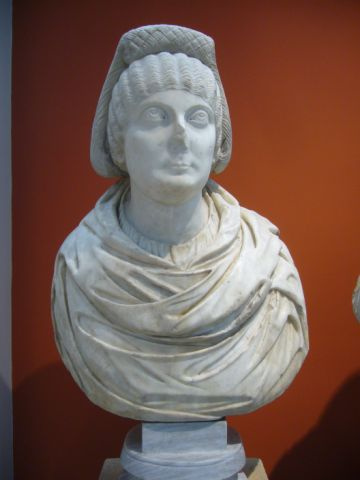
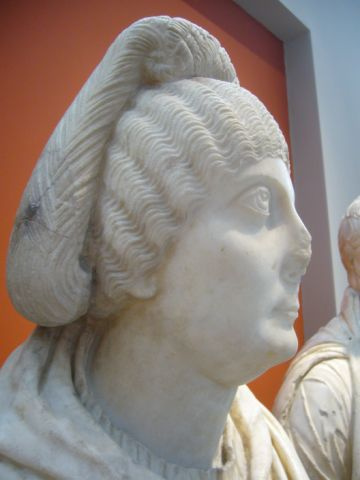
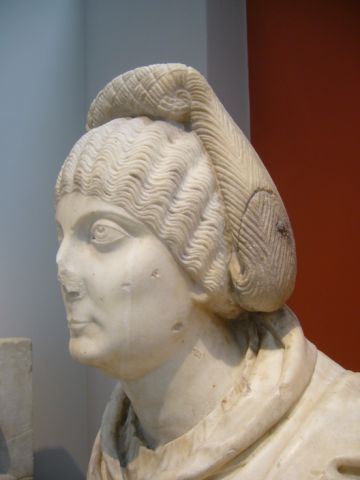
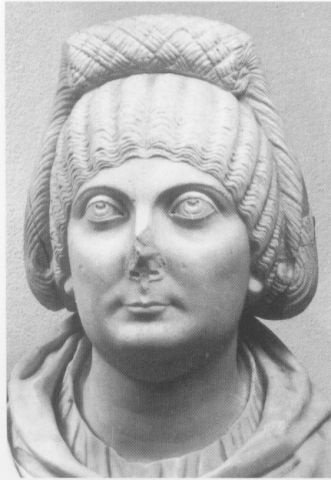
Bust of woman. From modern village of Naoussa (Macedonia). Early fifth century.
Record details
Photographs
Bibliography
- Despinēs, G, Stephanidou Tiveriou, Th, and Voutyras, E., Katalogos glyptōn tou Archaiologikou Mouseiou Thessalonikēs I-III, Thessaloniki 1997-2010, III, 196-200, no. 523
- L'Orange, H. P., 'Der subtile Stil. Eine Kunstströmung aus der Zeit um 400 n. Chr.', Antike Kunst , 4 (1961) 68-75
- Rüsch, A., Das kaiserzeitliche Porträt in Makedonien, Jahrbuch des Deutschen Archäologischen Instituts 84, 1969, 59-196, p. 130-1 no. P36 fig. 44-5
- Schade, K., Frauen in der Spä̈tantike: Status und Repräsentation , Mainz 2004, p. 206-7 no. I 47 pl. 55,1
Discussion
DESCRIPTION (Object)
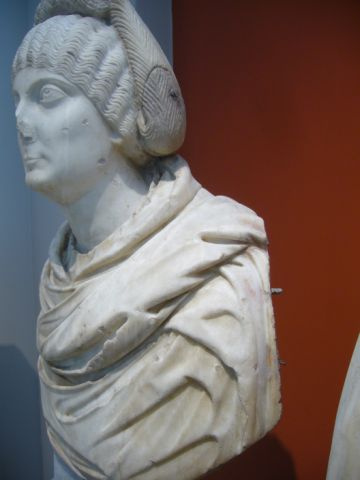
Bust of fine grained marble, probably pentelic; H (total) 76, (without foot) 59.5 cm. The foot was separately worked and is a modern copy after the male pendant (LSA-90). The tip of the nose is broken. At the back, on both sides of the large braid a portion has been cut off and reinserted with metal dowels. At the left rear margin of the bust, likewise a portion has been cut off; metal pins to fix it are sticking out the surface. The cuts both in the hair and at the bust are certainly antique.
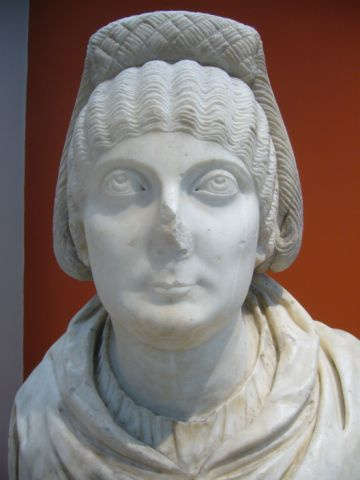
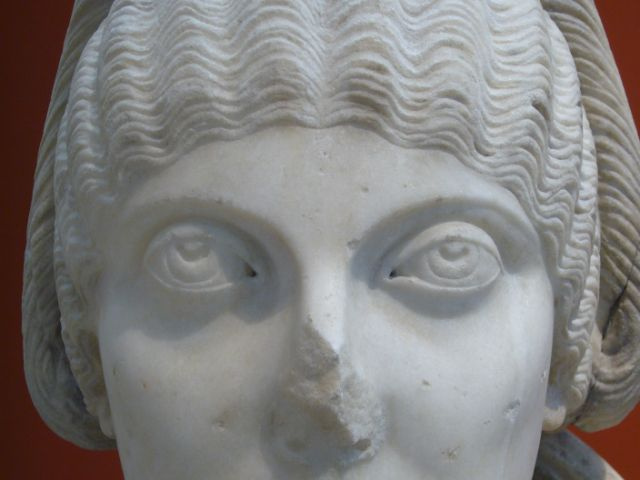
The hair is articulated into symmetrically braided patterns by fine chiselwork. The eyes are enlarged; the eyebrows are regular arches without indication of hair. The arching line of the eyebrows is paralleled by the drill line that separates the orbital from the upper lid and by the upper lid itself. The large iris is circumscribed by a deeply incised circular line; the pupil is a point standing proud against the lunular drill line that confines it at its bottom.
The flesh is highly polished which makes a striking contrast against the braided patterns of the hair. No wrinkles disturb the shining smoothness of the surface, and there are very few subtle modelings, notably around the mouth and at the neck (see also below, ‘Description (Subject)’).
The cloak (palla; see also below, ‘Description (Subject)’) is characterized by heavy folds that are separated from each other by deep cuts; the heavy backs of the folds, on contrast, show smoothly modeled relief. The heavy material of the cloak is plastically different from the more subtle material of the tunic.
PROVENANCE AND CURRENT LOCATION
The head, together with its male counterpart LSA-90 was brought into Thessaloniki from the village of Naoussa, north of Mt. Olympus between Edessa and Veria (Beroia). It is today in the Thessaloniki Archaeological Museum, inv. no. 1060.
DESCRIPTION (Subject)
The portrayed is a lady of mature age; this is indicated by the full face and the chaste dress. She is wearing tunic and palla, the usual dress of the late antique noble lady. The palla is tightly wrapped around the body and covers the breast almost to the neck; of the tunic only a narrow strip is visible at the neck.
The lady has a full face, large eyes and a small mouth. Her rich hair is elaborately arranged into horizontal wavy strands at the forehead. In the neck it is combined into a massive central braid that is drawn onto the skull and rolled in at the peak of the head. The braid is covered by diagonal lines that form a symmetric pattern of small lozenges.
The smooth surface of the face is not disturbed by wrinkles; however, advanced age and individual appearance of the portrayed are indicated by the full face with the heavy chin, the small mouth, and the broad neck.
DATE
The hairstyle with the massive central braid that is rolled in at the centre of the skull reoccurs on coin portraits of the empresses Aelia Flacilla, (379-86; wife of Theodosius I) and Eudoxia (400-4; wife of Arcadius) (L’Orange 1961, 72 and pl. 29, 4). These indicators coincide with indicators that open a similar time frame for the male pendant LSA-91.
The stylistic features of our bust and its male pendant LSA-91 (fine modelings and polished smoothness contrasting with sharp cut lines; virtuous display of different materials and of individual features) were introduced as prototypical of the ‘subtle style’ of the era of the sons of Theodosius I around 400 (see particularly L’Orange 1961, 69-71).
Discussion references
- von Heintze, H. ‘Ein spätantikes Mädchenportät in Bonn. Zur stilitischen Entwicklung des Frauenbildnisses im 4. und 5. Jahrhundert’, Jahrbuch für Antike und Christentum 14, Münster 1971, 83, no. VI 5, pl. 17c and 19b (late fourth to early fifth century)
Cite: Last Statues of Antiquity, LSA-91 (Ulrich Gehn).