
LSA-910
Fragmentary slab, probably from base for statue, with dedication to an emperor. Sparta (Achaea). 290-324
Record details
Photographs
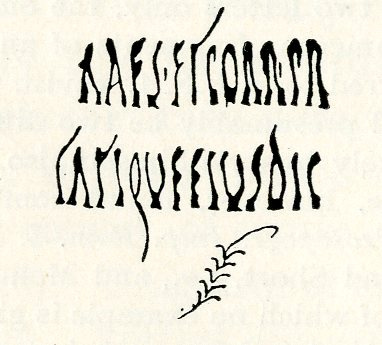
Inscription
[---] / [-- p]raes(es) et corr(ector) pr[ovinciae Achaiae?] / [numini maiest]atique eius dic(atissimus)
Inscription translation
... governor (praeses) and corrector of the province of Achaea, with the utmost reverence to his divine spirit and his majesty
Bibliography
- Šašel Kos, M., Inscriptiones Latinae in Graecia repertae. Additamenta ad CIL III , Faenza 1979, 30 no. 38
Discussion
INSCRIPTION
In two lines:
[---] / [-- p]raes(es) et corr(ector) pr[ovinciae Achaiae?] / [numini maiest]atique eius dic(atissimus).
'... governor (praeses) and corrector of the province of Achaea, with the utmost reverence to his divine spirit and his majesty'.
We reproduce the inscription with the completions given by Sasel Kos 1979 which we think are well founded. Woodward 1928 completed line 2 as follows: [---le]gatique eius dic--- - '...and of his legate' and thought dic--- was a form of dicere.
Letter height 3-3.6 cm.
DESCRIPTION (from Sasel Kos 1979 and Woodward 1928)
Small fragment of a slab of greyish marble, broken on three sides, only the lower edge preserved. Height 18 cm, width 13 cm, depth 25 cm. If this is part of a statue dedication, it must have been part of the facing of a base in other materials. There is no published photo.
PROVENANCE/ LOCATION
The fragment was found in 1926 near the South-East corner of the stage of the theatre in Sparta (Woodward 1928). Now in the Sparti museum, inv. no. 2880.
HONORAND, AWARDER AND DATE
The inscription uses a formula common in dedications to emperors of the tetrarchic period. The awarder was a governor of Achaea with the rank of a praeses. Achaea was administered by proconsuls until, in the wake of the provincial reforms of the 290s, Diocletian downgraded it to a province of the lowest rank, administered by a praeses of equestrian rank. This lasted until it was re-elevated to a proconsular province under Constantine in 324 (Groag 1946, 16). Our man additionally held the traditional office of corrector of the free cities (legatus Augusti ad corrigendum statum liberarum civitatum, see Groag 1939, 125-33, 162-6, cf. also LSA-97).
FURTHER DISCUSSION
It is impossible to be certain, but this is most likely to be part of a statue dedication.
Discussion references
- Groag, E., Die Reichsbeamten von Achaia in spätrömischer Zeit, Budapest 1946
- Groag, E., Die Römischen Reichsbeamten von Achaia bis auf Diokletian (Schriften der Balkankommision, Antiquarische Abteilung IX), Wien & Leipzig 1939, 136, 125-33, 162-6
- Woodward, A. M., Excavations at Sparta, 1924-1928, The Annual of the British School at Athens XXIX, London 1927-1928, 53-4 no. 80
Cite: Last Statues of Antiquity, LSA-910 (Ulrich Gehn).