
LSA-911
Base for statue of Constantius I, Constantine I, Constantine II, Constantius II, or Constans. Sparta (Achaea). 305-361
Record details
Photographs
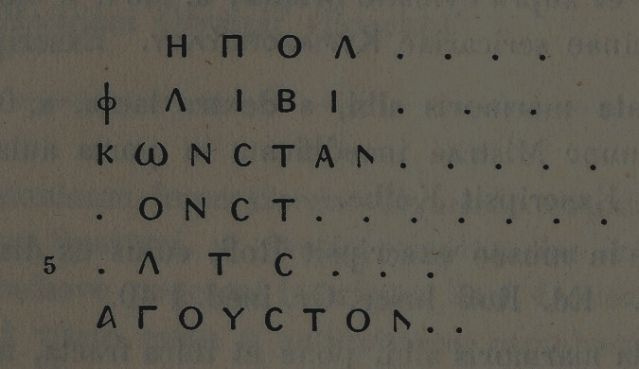
Inscription
Ἡ πόλι[ς] --- / Φλ[α]βι[ον Βαλ(έριον)?] / Κωνσταν̣[τῖνον?] / [τ]ὸν ἐ̣π̣[ιφανέσ-] / [τ]α̣το[ν] Ἄγοστον̣.
Inscription translation
The city ... (set this up to) Flavius Valerius (?) Constantinus (?) the most noble Augustus.
Bibliography
- Inscriptiones Graecae, V, 1, 451
Discussion
INSCRIPTION
In five lines:
Ἡ πόλι[ς] --- / Φλ[α]βι[ον Βαλ(έριον)?] / Κωνσταν̣[τῖνον?] / [τ]ὸν ἐ̣π̣[ιφανέσ-] / [τ]α̣το[ν] Ἄγουστον̣.
'The city ... (set this up to) Flavius Valerius Constantinus (?) the most noble Augustus'.
The imperial name in line 2-3 has been expanded to Φλάβιον Βαλέριον Κωνσταντῖνον - Flavius Valerius Constantinus by Inscriptiones Graecae (IG), arguing that the inscription was to Constantine I. Of the nomen Valerius, however, nothing is extant and it could be Iulius or Claudius likewise; the name in line 3, consequently, could be extended to Constantinus, Constantius, or Constans (see below, 'Honorand and Date').
DESCRIPTION (from IG V)
Described by IG as a base broken at right side and bottom (in basi a dextra infraque mutilata). No measurements are published, and there is no published image.
PROVENANCE/ LOCATION
The base is said to have been seen by Fourmont in Magoula, which is today's Demos Mistra and the centre of ancient Sparta. CIG 1324 writes it was in Sparta, 'by the temple of Lycurgus' (Spartae iuxta templum Lycurgi). No information on its current location is given by IG.
HONORAND AND DATE
The name of the honorand is mutilated. It was extended to 'Flavius Valerius Constantinus' (Constantine I, Augustus 306-37) by IG, but there are other possibilities: 'Flavius Valerius Constantius' (Constantius I); Flavius Claudius Constantinus (Constantine II, Augustus 337-40); Flavius Iulius Constantius (Constantius II, Augustus 337-61); Flavius Iulius Constans (Constans, Augustus 337-50). In Sparta there is another inscription to Constantius I (IG V, 1, 450 = LSA-909), which spells his name differently to the present inscription (Κονστάντιον in LSA-909 as opposed to Κωνστάν[τιον] in the present inscription). This, however, by no means proves that the present dedication is to Constantine. We have therefore adopted an outer date-range, including the reign of Constantius I as Augustus (305-306) and of Constantine's sons.
Discussion references
- Inscriptiones Graecae; , V, 1, 450
- Kienast, D., Römische Kaisertabelle. Grundzüge einer römischen Kaiserchronologie, Darmstadt (2)1996, 295
Cite: Last Statues of Antiquity, LSA-911 (Ulrich Gehn).