
LSA-912
Base for statue of Constantius I, emperor. From Asopus (Achaea). 293-305
Record details
Photographs
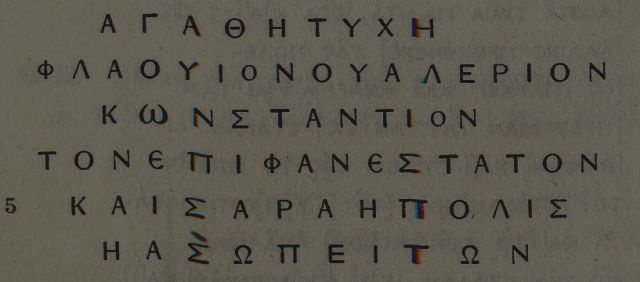
Inscription
Ἀγαθῇ τύχῃ / Φλάουιον Οὐαλέριον / Κωνστάντιον / τὸν ἐπιφανέστατον /(5) καίσαρα ἡ πόλις / ἡ Ἀσωπειτῶν.
Inscription translation
To good fortune. The city of the Asopeitans [set this up to] Flavius Valerius Constantius the most noble Caesar.
Bibliography
- Inscriptiones Graecae, V, 1, 969
Discussion
INSCRIPTION
In six lines:
Ἀγαθῇ τύχῃ / Φλάουιον Οὐαλέριον / Κωνστάντιον / τὸν ἐπιφανέστατον /(5) καίσαρα ἡ πόλις / ἡ Ἀσωπειτῶν.
'To good fortune. The city of the Asopeitans (set this up to) Flavius Valerius Constantius the most noble Caesar'.
DESCRIPTION
No description is given by Inscriptiones Graecae (IG), there are no published measurements, and there is no published image.
PROVENANCE AND MOST RECENTLY RECORDED LOCATION
The base was set up in the city of Asopus in southern Laconia; according to IG which is based on the 17th century author Prideaux, it was later brought to Oxford. There is no recent record of its present location.
HONORAND, AWARDER AND DATE
Constantius I (Constantius Chlorus) was Caesar 293-305.
The inscriptions was set up by the city of Asopus.
This statue was probably accompanied by similar ones to the other emperors of the tetrarchy.
Cite: Last Statues of Antiquity, LSA-912 (Ulrich Gehn).