
LSA-914
Base for statues of Constantine I and Licinius, emperors. Aigosthena (Achaea). 310-314
Record details
Photographs
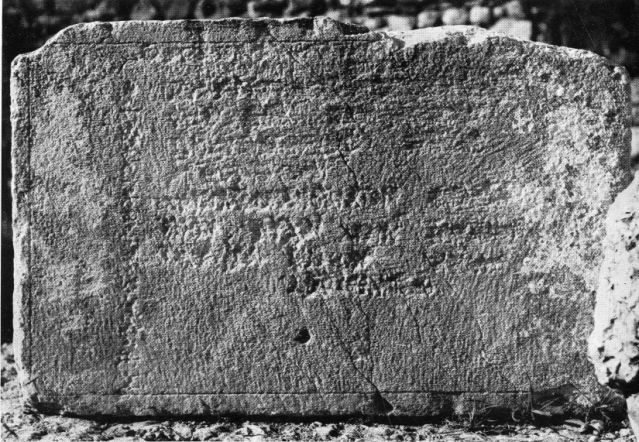
Inscription
Τὸν [μέγιστον καὶ θειό]τατον [αὐτοκρά- ]/τ̣ο̣ρ̣α̣ Σ̣ε̣[βαστ]ὸ̣ν ------------- (?) / Φλάβ(ιον) Οὐαλ(έριον) Κω[νσ]τα[ντῖνον] / τὸν κύ[ριον ἡμῶν ἡ πό]λις /(5) Αἰγ[οσθενιτῶν] // [Τὸν μέ]γιστον [κ]α[ὶ θ]ειότατον Σεβα[στὸν ἀδε- ]/λφὸν Οὐαλ(έριον) Λικιν(νιανὸν) Λικίνν[ιον] / τὸν κύριον ἡμῶν ἡ [π]όλις / Αἰγοσθενιτῶν.
Inscription translation
The city of the Aigosthenitans (set this up to) the highest and most divine emperor Augustus (...) Flavius Valerius Constantinus, our Lord. The city of the Aigosthenitans (set this up to) the highest and most divine Augustus brother Valerius Licinianus Licinius, our Lord.
Bibliography
- Supplementum epigraphicum graecum, Amsterdam 1923-, 23, 1968, no. 266
- L'Année épigraphique, , 1966 p. 108-9 no. 380
Discussion
INSCRIPTION
In nine lines:
Τὸν [μέγιστον καὶ θειό]τατον [αὐτοκρά- ]/τ̣ο̣ρ̣α̣ Σ̣ε̣[βαστ]ὸ̣ν ------------- (?) / Φλάβ(ιον) Οὐαλ(έριον) Κω[νσ]τα[ντῖνον] / τὸν κύ[ριον ἡμῶν ἡ πό]λις /(5) Αἰγ[οσθενιτῶν] // [Τὸν μέ]γιστον [κ]α[ὶ θ]ειότατον Σεβα[στὸν ἀδε- ]/λφὸν Οὐαλ(έριον) Λικιν(νιανὸν) Λικίνν[ιον] / τὸν κύριον ἡμῶν ἡ [π]όλις / Αἰγοσθενιτῶν.
'The city of the Aigosthenitans (set this up to) the highest and most divine emperor Augustus (...) Flavius Valerius Constantinus, our Lord. The city of the Aigosthenitans (set this up to) the highest and most divine Augustus brother Valerius Licinianus Licinius, our Lord'.
We reproduce the inscription in the reading by Vatin 1966.
DESCRIPTION (from the published photo)
Rectangular limestone block with minor breaks at left top angle, right top front edge, and right side. The inscribed surface is finished with a claw, the epigraphic field is framed by a thin incised line visible at top, bottom and left, but not at right side. The block bears an earlier inscription, datable to the 2nd century BC, that reads Ἡρέας Διονυσίου – 'Hereas, son of Dionysios' -it was used as a funerary stele at that time. When re-used for the present dedication, it was set on its original left side, so that the original inscription now runs vertically, to the left of our inscription (both inscriptions being cut on the same face of the block). Both inscriptions were later lightly erased, probably by the masons who built the early Byzantine basilica. An inscription to Licinius might have been erased deliberately for political reasons, but not one to Constantine.
No measurements are given in the publications; from the photograph it would seem that the original base was set deliberately on its side in order to take two statues.
PROVENANCE/ LOCATION
The base was found in the ruins of the early Byzantine basilica in Aigosthena (Vatin 1966, 243; for the basilica see Orlandos 1954). There is no published information on its present location.
HONORAND(S) AND DATE
Constantine I was Augustus from 306 to 337, but fully recognized in the East only from 310 onwards (Kienast 1996, 295), which provides one terminus post quem for the dedication. Licinius (Augustus of the East 308-324) is however styled 'Augustus brother' in the inscription, which, as Vatin points out, almost certainly alludes to the marriage between him and Constantine I's sister Constantia in 313, providing a later terminus post quem. The outbreak of the first war between the two emperors in 314 is a secure terminus ante quem, since after that date no city in the East would have raised a joint statue to Licinius's rival Constantine.
Discussion references
- Kienast, D., Römische Kaisertabelle. Grundzüge einer römischen Kaiserchronologie, Darmstadt (2)1996, 295
- Orlandos, A. K., Anaskaphe tes basilikes ton Aigosthenon, Πράκτικα της εν Αθήναις Αρχαιολογικής Εταιρείας 1954, 129-142, Athens 1957
- Vatin, C., Quelques inscriptions d'époque impériale, Bulletin de Correspondance Hellénique 90, 240-7, Paris 1966, 243-4 fig. 2
Cite: Last Statues of Antiquity, LSA-914 (Ulrich Gehn).