
LSA-915
Base for statue of Constantine II, emperor. Aigosthena (Achaea). 317-340
Record details
Photographs
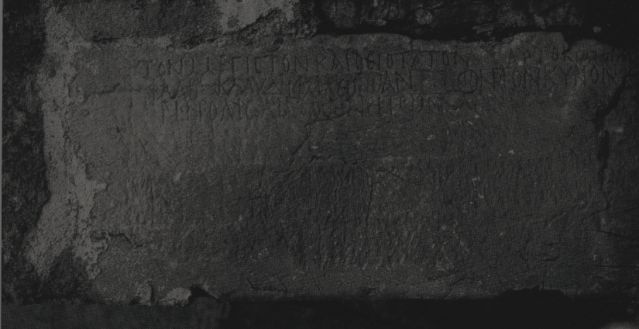
Inscription
Τὸν μέγιστον καὶ θειότατον αὐτοκράτορα / Φλάβς Κλαύδς ιον Κων(σ)ταντῖνον τὸν κύριον / ἡμῶν ἡ πόλις Αἰγοσθενειτῶν
Inscription translation
The city of the Aigosthenitans [set this up to] the greatest and most divine emperor Flavius Claudius Constantinus, our Lord
Bibliography
- Supplementum epigraphicum graecum, Amsterdam 1923-, 23, 1968, 267
- L'Année épigraphique, , 1966 p. 109 no. 381
Discussion
INSCRIPTION
Τὸν μέγιστον καὶ θειότατον αὐτοκράτορα / Φλάβς Κλαύδς ιον Κων(σ)ταντῖνον τὸν κύριον / ἡμῶν ἡ πόλις Αἰγοσθενειτῶν
'The city of the Aigosthenitans [set this up to] the greatest and most divine emperor Flavius Claudius Constantinus, our Lord'
We reproduce the reading given by Vatin 1966 and followed by SEG. The excavator A. Orlandos published a slightly different reading of the imperial name in the second line:
Τὸν μέγιστον καὶ θειότατον αὐτοκράτορα / Φλάβ(ιον) Κλαύδιο[ν Κωνστ]αντ[εῖ]νον τὸν κύριον / ἡ πόλις Αἰγοσθενειτῶν
DESCRIPTION (from Orlandos 1954, Vatin 1966, and the published photo)
Rectangular block of marble. The surface is roughly finished, with several cracks. The measurements are from Orlandos 1954. The inscription is cut horizontally on the longest side of the block. According to Orlandos, the inscription is 'on the one side' of the block, while 'on the other side' there are imprints of the feet of a bronze statue, which he links explicitly with this inscription ('Εἶναι δ’αὕτη κεχαραγμένη ἐπὶ <b>τῆς</b> μιᾶς πλευρᾶς μαρμαρίνου βάθρου χαλκοῦ ἀνδριάντος, τοῦ ὁπίου διακρίνονται ἐπὶ <b>τῆς ἄλλης πλευρᾶς τὰ διὰ τὰ διεστηκότα πέλματατῶν ποδῶν λαξεύματα') (my emphasis). However the published photograph strongly suggests that the imprints must be on the opposite face to the inscription, since the top face is concealed. If so, they presumably belong to an earlier use of the block.
PROVENANCE/ LOCATION
The base was discovered in the early 1950s during the excavations of the Christian basilica of Aigosthena. It is built into the North-East corner of the small Byzantine church built into the main aisle of the larger and earlier basilica (for a plan cf. Orlandos 1954, 141).
HONORAND AND DATE
Flavius Claudius Constantinus, one of the sons of Constantine I, was proclaimed Caesar in 317 and elevated to Augustus in 337. He was killed in 340. Constantine II took over the title maximus (Greek μέγιστος, line 1) after his father's death in 337; he applied it, in coinage as in epigraphy, as a sign of prevalence over his younger brothers until he died in 340 (Chastagnol 1976, 263-4).
The inscription dates to the period 337-40, when he exercised suzerainty over his brother Constans, the ruler of Illyricum in which Achaea lay (Vatin 1966, 243).
Discussion references
- Chastagnol, A., Les inscriptions constantiniennes du Cirque de Mérida, Mélanges de l'Ecole française de Rome. Antiquité vol. 88, N°1, pp. 259-276., Paris 1976
- Orlandos, A. K., Anaskaphe tes basilikes ton Aigosthenon, Πράκτικα της εν Αθήναις Αρχαιολογικής Εταιρείας 1954, 129-142, Athens 1957, 140-2
- Vatin, C., Quelques inscriptions d'époque impériale, Bulletin de Correspondance Hellénique 90, 240-7, Paris 1966, 242-4 no. III fig. 1
Cite: Last Statues of Antiquity, LSA-915 (Ulrich Gehn).