
LSA-928
Base for statue, possibly posthumous, of Constantine I, emperor. Delphi (Achaea). 317-340
Record details
Photographs
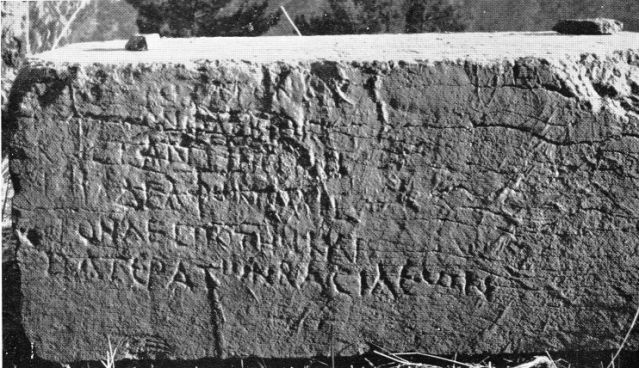
Inscription
[Τὸν θ]ειότατον [κ]ύ/ρ[ιον ἡμ]ῶν Φλάβιον / Κωστατντῖνον ἡ / ἱερὰ Δελφῶν πόλις /(5) τὸν δεσπότην καὶ / πατέρα τῶν βασιλέων.
Inscription translation
The holy city of the Delphians (set this up to) the our most divine Lord Flavius Constantinus, the ruler and father of the emperors.
Bibliography
- Colin, G., Inscriptions de la Terrasse du Temple et de la Région nord du Sanctuaire (Foilles de Delphes III, iv), Paris 1930, 295 no. 275
- Dittenberger, W., Sylloge Inscriptionum Graecarum. 3rd edition., Hildesheim - New York 1982, 903 B
Discussion
INSCRIPTION
In six lines:
[Τὸν θ]ειότατον [κ]ύ/ρ[ιον ἡμ]ῶν Φλάβιον / Κωστατντῖνον ἡ / ἱερὰ Δελφῶν πόλις /(5) τὸν δεσπότην καὶ / πατέρα τῶν βασιλέων.
'The holy city of the Delphians (set this up to) the our most divine Lord Flavius Constantinus, the ruler and father of the emperors'
The text was published with incorrect line-divisions and brackets by Colin 1930. We give the text in the improved reading by Vatin 1962, 230.
Letter height 2.5-4 cm.
DESCRIPTION (from Colin 1930 and the published photo)
Rectangular block of greyish limestone. Height 43 cm, width 118 cm, depth 46 cm. Epigraphic field not framed, surface weathered. Top right corner broken; back side broken according to Colin. According to Colin, 'appartenait à un degré de la krepis du temple' (i.e. was a re-used block from the base of the temple).
PROVENANCE/ LOCATION
The block was found on the Sacred Way East of the temple of Apollo. Today Delphi, Museum inv. no. 897. It was seen by Vatin in the western colonnade of the temple (Vatin 1962, 229).
HONORAND AND DATE
Constantine I was Augustus 306-37. This inscription in Delphi, and a further very similarly worded one (LSA-927), style him 'father of the emperors'; the most secure terminus post quem is therefore March 1st, 317, when Constantine's oldest sons Constantine II and Crispus were elevated to the rank of Caesar. The inscription and statue may be posthumous, since reference to the close family relation between Constantine I and his natural sons would fit well into the dynastic struggle that immediately followed his death in 337, when the descendants of Constantine's stepmother Theodora were killed, leaving his sons the only claimants to imperial power (Cameron and Garnsey 1998, 3-4).
Vatin also argued for a posthumous date, on the basis that Constantine himself had rejected the anti-traditional Greek title of βασιλεύς (Vatin 1962, 231). Moreover, he states that the only equivalents of the Greek πατὴρ τῶν βασιλέων ('father of the emperors') referring to Constantine are two inscriptions in Italy, from Fano (CIL XI 6218/19) and Rome (CIL VI 1151) (pater dominorum and pater principum respectively), both of which style Constantine divus, and are therefore certainly posthumous. The Fano inscription can be dated independently to the years 339/50 (PLRE I, 817-18 L. Turcius Secundus signo Asterius 6).
A date after Constantine's death, but close to it, is probable (although the Fano inscription shows that statues to him as 'father of the reigning emperors' were still being erected in 339 or later), but we cannot wholly exclude a date during his lifetime - hence our outer dates of 317-40.
FURTHER DISCUSSION
Four further dedications to emperors of the Constantinian dynasty are known from Delphi, another one for Constantine I (LSA-927), one for Dalmatius (LSA-929), one for Constans (LSA-930), and one for either Constantius I, Constans or Constantius II (LSA-1077). Vatin, who discussed them comprehensively, believed that they did not form a contemporary group, a conclusion with which we concur (Vatin 1962, 235).
Discussion references
- Corpus Inscriptionum Latinarum; , IX 6218/19
- Corpus Inscriptionum Latinarum; , VI 1151
- Cameron, Av. & Garnsey, P., The Late Empire, A.D. 337-425 (The Cambridge Ancient History Vol. XIII), Cambridge 1998
- Jones, A. H. M. et al., The Prosopography of the Later Roman Empire. Vol. I 260-395, Cambridge et al. 1971 (1975)
- Vatin, C., Les Empereurs du IVe siècle a Delphes, Bulletin de Correspondance Hellénique 86, 229-41, Paris 1962, 229-31
Cite: Last Statues of Antiquity, LSA-928 (Ulrich Gehn).