
LSA-929
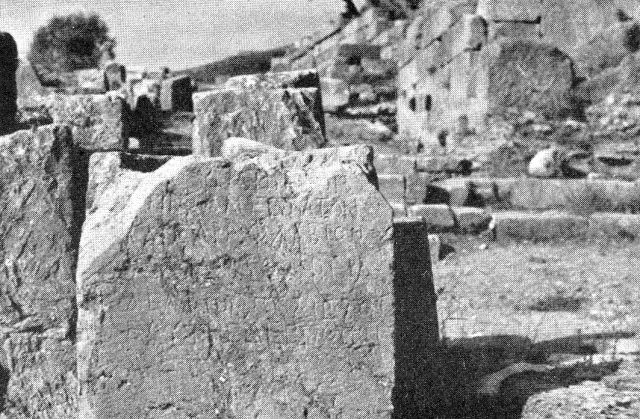
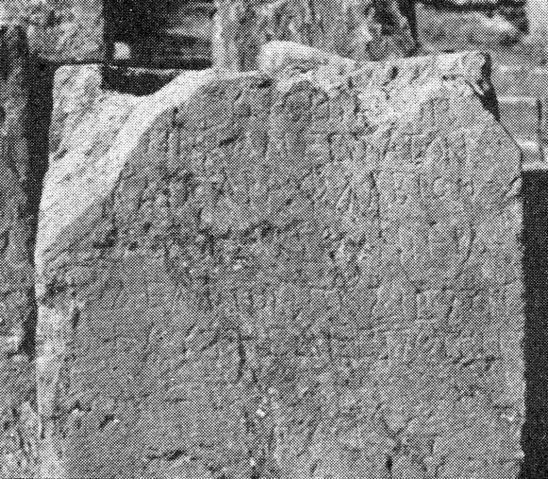
Base for statue of Dalmatius, emperor. Delphi (Achaea). 335-337
Record details
Photographs
Inscription
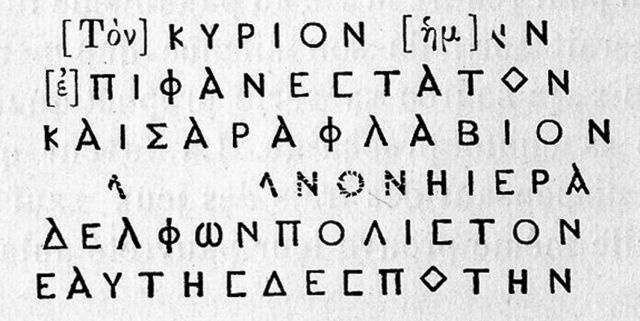
[[τὸ]ν̣ κύριον ἡ̣μ̣ῶν / [ἐ]πιφανέστατον / Καίσαρα Φλάβιον / [[Δαλμάτιον]] ἡ ἱερὰ / (5) Δελφῶν πόλις τὸν / ἑαυτῆς δεσπότην.
Inscription translation
The holy city of the Delphians (set this up to) our Lord the most noble Caesar Flavius Dalmatius, her master.
Bibliography
- L'Année épigraphique, , 1948 no. 50
Discussion
INSCRIPTION
In six lines:
[[τὸ]ν̣ κύριον ἡ̣μ̣ῶν / [ἐ]πιφανέστατον / Καίσαρα Φλάβιον / [[Δαλμάτιον]] ἡ ἱερὰ / (5) Δελφῶν πόλις τὸν / ἑαυτῆς δεσπότην.
'The holy city of the Delphians (set this up to) our Lord the most noble Caesar Flavius Dalmatius, her master'
The name of the honorand has been partly erased and was not read by Homolle 1896, but it was read with confidence by Daux 1939. We have placed it in double square brackets, to reflect the erasure (Daux published it without brackets).
Letter height 4 cm.
DESCRIPTION (from Homolle 1896, Daux 1939, and the published photos)
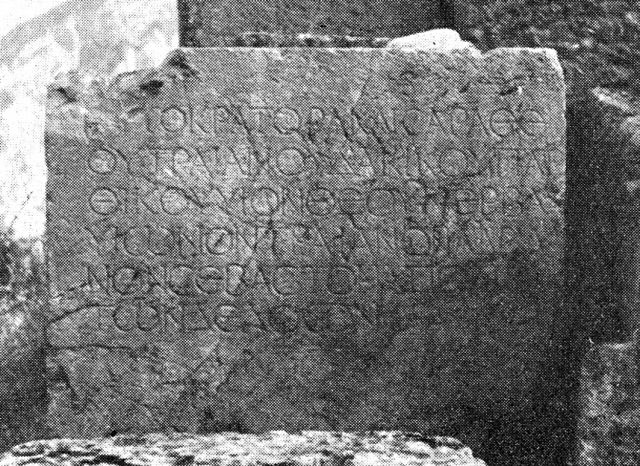
Rectangular block of local stone, without mouldings and frame. Height 91 cm, width 56 cm, depth 78 cm. On the right side (the original front side) is an inscription to Hadrian (SIG(3) 829 B). The top of the base is clearly damaged in part. Under the inscription for Dalmatius, in another hand, is a graffito, reading πόλις.
PROVENANCE AND CURRENT LOCATION
Found 1895 six metres outside the main entrance of the temenos. Its present location is not known to us.
HONORAND AND DATE
Flavius Iulius Dalmatius was a nephew of Constantine I and grandson of Constantius I (PLRE I, 241 Fl. Iulius Dalmatius 7). He was proclaimed Caesar in 335 and killed in 337. This inscription must have been defaced, after his fall, by his successful rivals.
FURTHER DISCUSSION
Four further dedications to emperors of the Constantinian dynasty are known from Delphi, two for Constantine I (LSA-927, LSA-928), one for Constans (LSA-930), and one for either Constantius I, Constans or Constantius II (LSA-1077). Vatin, who discussed them comprehensively, believed that they did not form a contemporary group, a conclusion with which we concur (Vatin 1962, 235).
Discussion references
- Daux, G., Inscriptions de Delphes, Bulletin de Correspondance Hellénique 63, 142-82, Paris 1939, 178-9 fig. 11, 12
- Homolle, M., Histoire du temple (fin), Bulletin de Correspondance Hellénique 20, 702-32, Paris 1896, 729
- Jones, A. H. M. et al., The Prosopography of the Later Roman Empire. Vol. I 260-395, Cambridge et al. 1971 (1975), 241 Fl. Iulius Dalmatius 7
Cite: Last Statues of Antiquity, LSA-929 (Ulrich Gehn).