
LSA-93
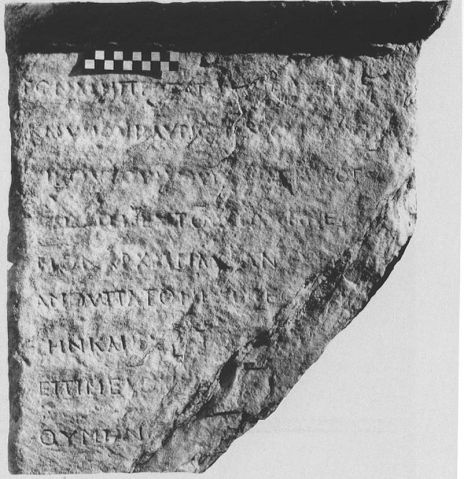
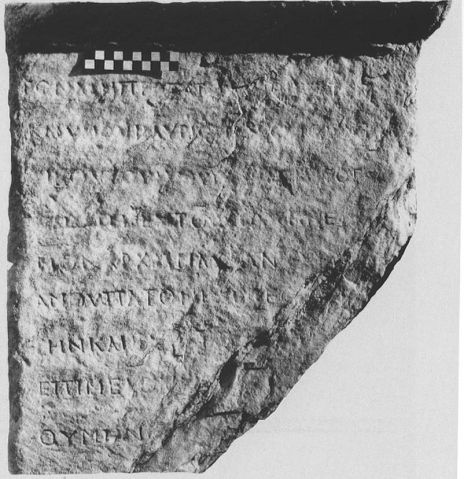
Fragmentary base for statue of Claudius Illyrius, governor of Achaea. Athens, Acropolis. Late third century
Record details
Photographs
Inscription
τὸν λ̣α̣μπρό̣τατον ἀνθύπ̣α̣το̣ν / Κλ̣α̣ύδ̣ιο̣ν Ἰλ̣λυριό̣ν,ἔγγο̣ν̣ο̣ν̣ Λ̣εον- /(3) τ̣ικο̣ῦ̣ τ̣ο̣ῦ ἀ̣ν̣θ̣υπ̣ατεύσαν̣τ̣ος /, παῖ̣δ[α] Τή̣[ρ]εν̣τος̣ τοῦ̣ τὴ̣ν ἐπώ[νυ]-/μον ἀ̣ρ̣χὴ̣ν̣ ἄρξα̣ντο[ς, τὸν] / (6) ἀνθ̣ύπατον καὶὶ Ἀ̣ρεο̣[παγί]/την καὶ εὐ̣εργέτ[η]ν ἡ [πόλις], /(9) ἐπιμελ̣ουμ[ένου Μάρκου Ἰουνί]/ου Μηνο̣[υκιανοῦ].
Inscription translation
The city [set this up to] the governor (anthupatos) of clarissimus rank, Claudius Illyrius – grandson of Leonticus the former governor, son of Terens the former holder of the office of eponymous archon – governor, member of the Areopagus, and benefactor. Marcus Iunius Minucianus took charge.
Bibliography
- Inscriptiones Graecae, II/III(2) 13263
Discussion
INSCRIPTION
In nine lines:
τὸν λ̣α̣μπρό̣τατον ἀνθύπ̣α̣το̣ν / Κλ̣α̣ύδ̣ιο̣ν Ἰλ̣λυριό̣ν, ἔγγο̣ν̣ο̣ν̣ Λ̣εον- /(3) τ̣ικο̣ῦ̣ τ̣ο̣ῦ ἀ̣ν̣θ̣υπ̣ατεύσαν̣τ̣ος /, παῖ̣δ[α] Τή̣[ρ]εν̣τος̣ τοῦ̣ τὴ̣ν ἐπώ[νυ]-/μον ἀ̣ρ̣χὴ̣ν̣ ἄρξα̣ντο[ς, τὸν] / (6) ἀνθ̣ύπατον καὶὶ Ἀ̣ρεο̣[παγί]/την καὶ εὐ̣εργέτ[η]ν ἡ [πόλις], /(9) ἐπιμελ̣ουμ[ένου Μάρκου Ἰουνί]/ου Μηνο̣[υκιανοῦ].
'The city [set this up to] the governor (anthupatos) of clarissimus rank, Claudius Illyrius – grandson of Leonticus the former governor, son of Terens the former holder of the office of eponymous archon – governor, member of the Areopagus, and benefactor. Marcus Iunius Minucianus took charge.'
Letter height 1-2 cm.
The surface is badly damaged and the reading difficult. Basic edition IG II/III (Kirchner); reread by Sironen. The letters underlined were read by Kirchner, but lost before Sironen recorded the inscription. Fortunately, the wording is identical to that on another base to Illyrius (LSA-94), confirming the reading in many places where it is now lost or very difficult.
DESCRIPTION (from Sironen 1997)
Rectangular statue base of white Pentelic marble, the lower part broken away with loss of text at right in lines 4-10; H 95, W 45, D 56 cm. There are clear traces of an older inscription erased with a chisel. Right side smoothly finished, back and left only roughly finished. Top with moulding, broken on left and back right. Imprints for the feet of a bronze statue on top.
PROVENANCE AND LOCATION
From the Acropolis. Now Athens, Epigraphic Museum, inv. no. 435.
As G. Deligiannakis points out, the Acropolis remained a favoured setting for honorary portrait dedications in Late Antiquity, 'on account of its association with Athens' glorious past but also its present, as a focal place of public ceremonial and traditional religion'.
HONORAND, AWARDER AND DATE
Claudius Illyrius, an Athenian by birth, was awarded a second statue in Athens by the same Marcus Iunius Minucianus with exactly the same honorific inscription (LSA-94). A further statue, almost ceratinly to the same man, was set up in Corinth (LSA-60). From another Athenian inscription (IG II/III 5199, Sironen 1994 no. 4), Illyrius is known to have rebuilt the Athenian walls after the Herulian incursion of 267. This building activity has long led to a mid 3rd century date for his governorship (PIR(2) p. 207 no. 892; Groag 1939, 94), apparently corroborated by the identity of the awarder (dated to the mid-3rd century by Traill 2003, 376 no. 654170; but see also Millar 1969, 17). However, recent research now dates the wall "firmly ... in the reign of Probus (276-282) or slightly later" (Frantz 1988). This provides a date in the late 270s or the 280s for Claudius Illyrius. His governorship must have been held before Diocletian's provincial reforms, which downgraded the rank of the governor of Achaea to that of hegemon (Latin, praeses) - since Illyrius is described as anthupatos (Latin, 'proconsul') in the Athenian inscriptions. A date in the late 3rd century for our inscription today seems widely accepted (Millar 1969; Christol 1986, 177-182; Sironen 1994, 20 no. 2, 21-2 no. 4).
The awarder Marcus Iunius Minucianus is recorded in the other Athenian base inscription to Illyrius (LSA-94) as taking charge for the execution of a decree by the civic bodies of Athens. He must have been a local notable.
Discussion references
- Christol, M., Essai sur l'évolution des carrières sénatoriales dans la 2e moitié du IIIe siècle ap. J. C., Paris 1986, 177-82
- Deligiannakis, G., Late Antique Honorific Statuary from the province of Achaia, A.D. 300-600: A contribution to the topography and public culture of late antique Greece, Psaroudakes, K. & E. Sioumpara (eds.), Festschrift for Professor P.G. Themelis, Athens, 2010, 17-19
- Frantz, A., Late Antiquity A. D. 267 - 700: The Athenian Agora XXIV, Princeton 1988, 9-11
- Groag, E., Die Römischen Reichsbeamten von Achaia bis auf Diokletian (Schriften der Balkankommision, Antiquarische Abteilung IX), Wien & Leipzig 1939, 94
- Groag, E. & A. Stein, Prosopographia Imperii Romani Saec. I. II. III Pars II, Berlin & Leipzig 1936, 207 no. 892
- Millar, F., P. Herennius Dexippus: The Greek World and the Third-Century Invasions, Journal of Roman Studies 59, 12-29, London 1969, 17
- Sironen, E., The late Roman and early Byzantine inscriptions of Athens and Attica, Dissertation - University of Helsinki 1997, 59-61 no. 5
- Sironen, E. , 'Life and administration of late Roman Attica in the light of public inscriptions'
P. Castrén, Post-Herulian Athens : aspects of life and culture in Athens, A.D. 267-529 , Helsiniki 1994, 15-62, 19-20 no. 2 - Traill, J. S., Persons of Ancient Athens, Vol 12, M- to Moses, Toronto 2003, 376 no. 654170
Cite: Last Statues of Antiquity, LSA-93 (Ulrich Gehn).