
LSA-930
Base for statue of Constans, emperor. Delphi (Achaea). 337-350
Record details
Photographs
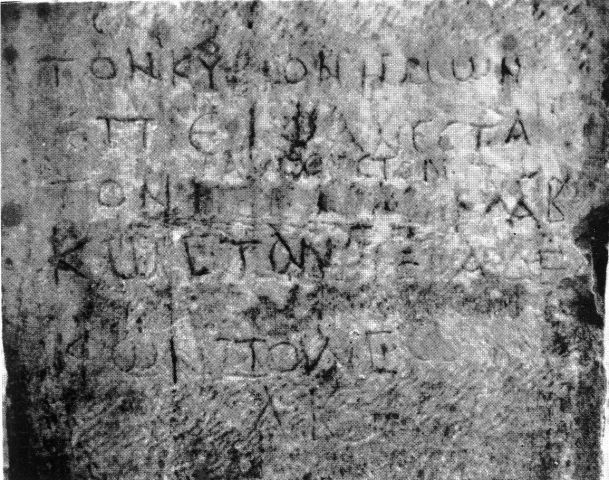
Inscription
Τὸν κύριον ἡμῶν / ἐπειφανέστα- / τον Αὔγουστον Φλαβ(ιον) / Κώσταν ἡ ἰερὰ Δέλ̣/φῶν πόλις.
Inscription translation
The holy city of the Delphians (set this up to) our Lord the most noble Augustus Flavius Constans
Textual evidence
The Troad. An Archaeological and Topographical Study
Bibliography
- Supplementum epigraphicum graecum, Amsterdam 1923-, 22, 469
- Dittenberger, W., Sylloge Inscriptionum Graecarum. 3rd edition., Hildesheim - New York 1982, 903 D
Discussion
INSCRIPTION
In five lines:
Τὸν κύριον ἡμῶν / ἐπειφανέστα- / τον Αὔγουστον Φλαβ(ιον) / Κώσταν ἡ ἰερὰ Δέλ̣/φῶν πόλις.
'The holy city of the Delphians (set this up to) our Lord the most noble Augustus Flavius Constans'.
In line 3, the word Σέβαστον has been erased and Αὔγουστον written in smaller letters above.
Letter height 1.7-3.5 cm.
DESCRIPTION (from Daux & Salac 1932, Vatin 1962, and the published photo)
Tall rectangular base of white marble, moulded at top and bottom. Height 115 cm, width 43 cm, depth 42 cm.The base was originally used for a statue of Polydeukion, one of the three adoptive sons of Herodes Atticus. Our inscription is on the back side in relation to the original one. According to Vatin, the re-use for Constans is not the first one. Indeed on the published photo, above and below our inscription, there appear to be letters that presumably belonged to an earlier inscription.
PROVENANCE/ LOCATION
The base was found in 1895 on the Roman forum of Delphi, now in the Delphi Museum inv. no. 3251. It must originally have stood in the Exedra of Herodes Atticus at Delphi.
HONORAND AND DATE
Flavius Iulius Constans, the youngest son of Constantine I, was Augustus from 337 to 350, when he was killed by the usurper Magnentius. He was in his early teens when the empire was divided among Constantine's three extant sons, on the emperor's death in 337. Although he was formally in charge of Illyricum, Italy and Africa, his older brother Constantine II attempted to assert senior authority over him (Cameron & Garnsey 1998, 4-5); this led to conflict and Constantine II's defeat and death in 340.
The titles used to describe Constans, and the curious alteration of Σέβαστος to Αὔγουστος, are discussed by Vatin, arguing that these reflect Constans' role as a lesser emperor, under the suzerainty of Constantine II between 337 and 340 (Vatin 1962, 234-5).
FURTHER DISCUSSION
Four further dedications to emperors of the Constantinian dynasty are known from Delphi, two for Constantine I (LSA-927, LSA-928), one for Dalmatius (LSA-929), and one for either Constantius I, Constans or Constantius II (LSA-1077). Vatin, who discussed them comprehensively, believed that they did not form a contemporary group, a conclusion with which we concur (Vatin 1962, 235).
Discussion references
- Cameron, Av. & Garnsey, P., The Late Empire, A.D. 337-425 (The Cambridge Ancient History Vol. XIII), Cambridge 1998
- Daux, G. & Salac, A., Inscriptions depuis le Trésor des Athéniens jusque'aux Bases de Gélon (Fouilles de Delphes III iii), Paris 1932, 55 no. 75
- Vatin, C., Les Empereurs du IVe siècle a Delphes, Bulletin de Correspondance Hellénique 86, 229-41, Paris 1962, 232-5 fig. 2
Cite: Last Statues of Antiquity, LSA-930 (Ulrich Gehn).