
LSA-931
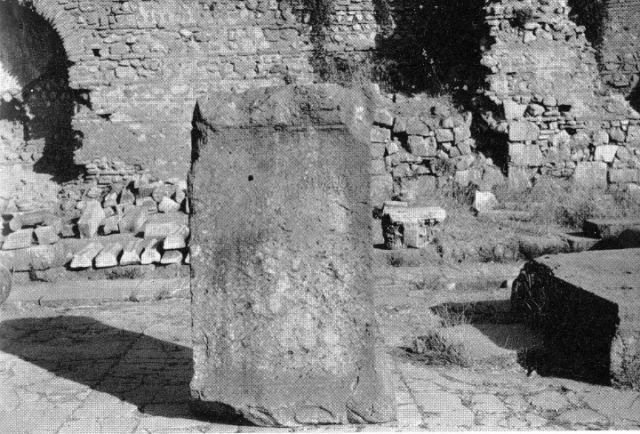
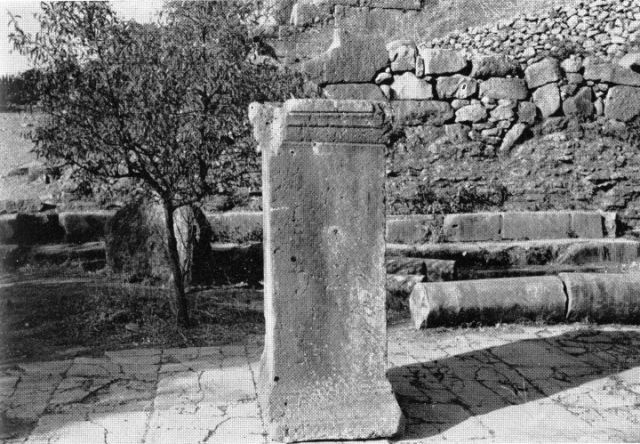
Base for statues of Valentinian I and Valens, emperors. Delphi (Achaea). 364-367
Record details
Photographs
Inscription
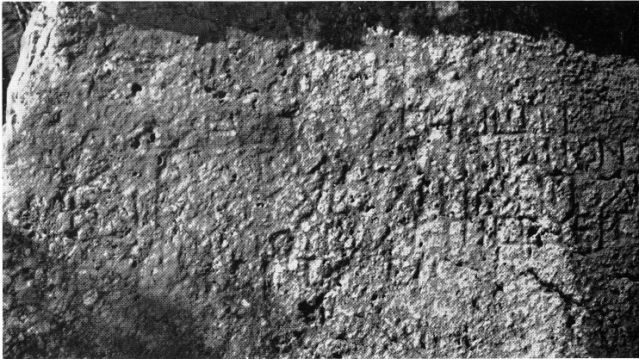
Τοὺς δεσπότας ἡμῶν / Φλ(αβιον) Ἰούλ(ιον) Βαλλε[ντ]ινιανὸν / καὶ Φλ(αβιον) Ἰούλ(ιον) Βάλη̣τ̣α̣ ἡ πόλις / Δελφῶν τοὺς ἑαυτἡς εὐεργέ- / τας ἀνέστησεν.
Inscription translation
The city of the Delphians set (this) up (to) our Lords Flavius Iulius Valentinianus and Flavius Iulius Valens, her benefactors
Bibliography
- Supplementum Epigraphicum Graecum, , XXII 470
Discussion
INSCRIPTION
In five lines:
Τοὺς δεσπότας ἡμῶν / Φλ(αβιον) Ἰούλ(ιον) Βαλλε[ντ]ινιανὸν / καὶ Φλ(αβιον) Ἰούλ(ιον) Βάλη̣τ̣α̣ ἡ πόλις / Δελφῶν τοὺς ἑαυτἡς εὐεργέ- / τας ἀνέστησεν.
'The city of the Delphians set (this) up (to) our Lords Flavius Iulius Valentinianus and Flavius Iulius Valens, her benefactors'.
Letter height 4 cm.
DESCRIPTION (from Vatin and the published photos)
Tall rectangular base in local stone, moulded at top and bottom. Height 162 cm, width 85 cm, depth 56 cm. The mouldings surround all four sides. At the front side there are breaks in the bottom moulding, at the top right corner, and the upper left corner. The surface is weathered, making the text difficult to read. On the top face Vatin saw holes for the insertion of two bronze statues ('trous de scellements de deux statues de bronze serrées l'une contre l'autre'). This large base carried statues of both emperors.
PROVENANCE/ LOCATION
The base was seen on the Roman Forum of Delphi by Vatin 1962, where it probably is still in situ. Delphi Museum inv. no. 7714.
HONORANDS, AWARDER AND DATE
Valentinian I (full name Flavius Valentinianus) was Augustus 364-75, his brother Valens (full name Flavius Valens) 364-78. The date range for the inscription is narrowed by the fact that in 367 Valentinian's eldest son Gratian joined the imperial college. He would certainly have been mentioned if already in office.
Both imperial names are given with the extraneous nomen Iulius, unparalleled as far as we are aware (cf. Vatin 1962, 238).
The city of the Delphians signs without its usual epithet ἱερὰ - 'holy' (' ἡ ἱερὰ Δελφῶν πόλις'), still in use in the dedications to the emperors of the Constantinian dynasty in that city (LSA-927, LSA-928, LSA-929, LSA-930, LSA-1077). This may have been felt inappropriate in the firmly Christian reigns of Valens and Valentinian (cf. Vatin 1962, 240-1).
FURTHER DISCUSSION
The precise motive for the elevation of these statues is not stated in the inscription; however Vatin 1962, 241 points out that an earthquake struck Greece in 365. The benefactions alluded to by the text might well refer to help in the reconstruction of the city.
The base is a rare example which actually bore two statues for the two emperors mentioned in the inscription. Its high quality is in striking contrast to the rather poor monuments for the Constantinian dynasty in Delphi (LSA-927, LSA-928, LSA-929, LSA-930, LSA-1077), as is the fact that it was obviously newly made for the statues of Valentinian I and Valens.
Discussion references
- Vatin, C., Les Empereurs du IVe siècle a Delphes, Bulletin de Correspondance Hellénique 86, 229-41, Paris 1962, 238-41
Cite: Last Statues of Antiquity, LSA-931 (Ulrich Gehn).