
LSA-932
Base for statue of Galerius or Maximinus Daia, emperors. Photike (Epirus Vetus). 293-313
Record details
Photographs
Inscription
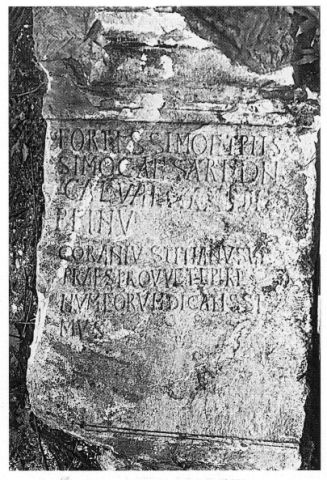
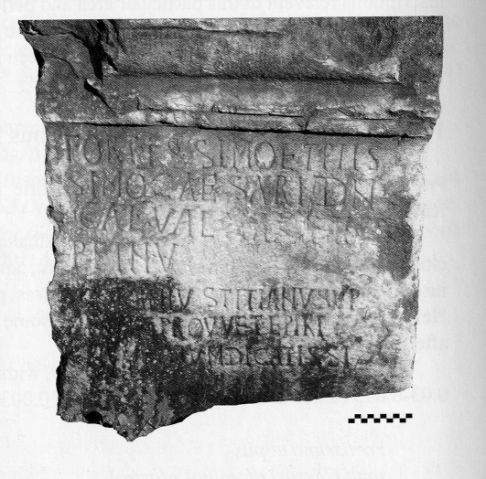
Fortissimo et piis- / simo Caesari d(omino) n(ostro) / Gal(erio) Val(erio) [[Maximino]] / p(io) f(elici) inv(icto) / Coranius Titianus v(ir) p(erfectissimus) / praes(es) prov(inciae) vet(eris) Epiri / num(ini) eorum (sic) dicatissi- / mus.
Inscription translation
Coranius Titianus, man of perfectissimus rank (and) governor (praeses) of the province of Epirus Vetus (set this up to) the most powerful and most pious Caesar our Lord Galerius Valerius Maximinus (or Maximianus) the pious, fortunate, invincible, with the utmost devotion to their divine spirit.
Bibliography
- Sironen, E., Some notes on Inscriptions of Roman Date from Thesprotia, Thesprotia Expedition I. Towards a Regional History (ed. B. Forsén), 185-96, Helsinki 2009, 185-6 no. 1
Discussion
INSCRIPTION
In eight lines:
Fortissimo et piis/simo Caesari d(omino) n(ostro) / Gal(erio) Val(erio) [[Maximino]] / p(io) f(elici) inv(icto) /(5) Coranius Titianus v(ir) p(erfectissimus) / praes(es) prov(inciae) vet(eris) Epiri / num(ini) eorum (sic) dicatissi- / mus.
'Coranius Titianus, of perfectissimus rank, governor (praeses) of the province of Epirus Vetus, (set this up to) the most powerful and most pious Caesar our Lord Galerius Valerius Maximinus (or Maximianus) the pious, fortunate, invincible, with the utmost devotion to their divine spirit'
Letter height 5 cm in lines 1-4 (with the imperial name and titles); 3 cm in lines 5-8 (with the name and title of the awarder).
The imperial name has been partly erased in line 3; the inscription was dedicated to either Galerius (full name: Caius Galerius Valerius Maximianus) or Maximinus Daia (full name: Galerius Valerius Maximinus Daia). In line 4, a large space has been left uninscribed in which the word Augustus, required by the sense, would fit. There is no obvious reason why it was omitted. Heil 1995 added it without justification.
DESCRIPTION (from the published photos)
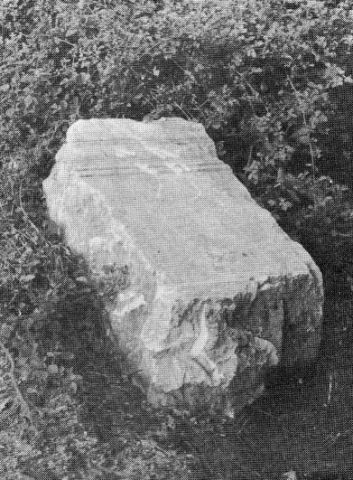
Tall rectangular marble base, moulded at top and bottom. H 99 cm, W 67 cm, D 67 cm. Mouldings badly broken at bottom, and at top right. The base is confusingly different in the photos published by Preka (here image 1), Sironen (image 2), and Papadopoulou (image 3). Preka's and Sironen's images clearly show the same inscription, but, whereas the base is complete (besides superficial damage) in Preka's and Papadopoulou's publications, it is horizontally broken under the epigraphic field in Sironen 2009.
PROVENANCE AND CURRENT LOCATION
The base was found in 1988 in the village of Hagios Athanasios, close to the church of Panagia Lambovithra, on the banks of the Liveri stream, the region of the ancient city of Photike (http://www.trismegistos.org/place/12111). It is now in the 32nd Ephorate of Prehistoric and Classical Antiquities in Fragma Kalama, no. ΘΕ 6941.
HONORAND, AWARDER AND DATE
The imperial name, which has been partially erased, can be completed to either Galerius (proposed by Heil 1995) or Maximinus Daia (proposed by Sironen 2009). Galerius was proclaimed Caesar in 293 and was Augustus 305-11. Maximinus Daia was Caesar 306-10 and Augustus 310-13. The missing title in line 4 is impossible to explain. According to Heil 1995, 160 'Augustus' must per force be read into this gap, as part of a fixed formula (pius felix invictus Augustus). If this is correct, it will still not necessarily date the inscription more tightly, since the title of Augustus was often erroneously applied to Caesars during the tetrarchy (Heil 1995, 160-1 with n. 8). We have therefore chosen a date range from the elevation of Galerius to the rank of Caesar in 293, to the death of Maximinus Daia in 313.
The awarder Coranius Titianus may perhaps be identical with PLRE I, 917 Titianus 1, or Titianus 2. (The publication of PLRE I predated the discovery of this base.)
FURTHER DISCUSSION
The province of Epirus Vetus originated in the wake of the provincial reforms of the tetrarchy, after 293 (Heil 1995, 161 with n. 13). This base is the earliest known testimony to the new province, and Coranius Titianus its earliest known governor (Heil 1995, 161).
The plural eorum in line 7, referring to a plurality of emperors, is paralleled in a series of inscriptions from Timgad/ Thamugadi, each dedicated to a single Tetrarch. This suggests that the monument in Photike was one of a group of bases to the tetrarchs, each bearing a statue of one of the college (Heil 1995, 162-3).
Discussion references
- Heil, M., Zwei spätantike Statthalter aus Epirus und Achaia, Zeitschrift für Papyrologie und Epigraphik 108, 159-65, Bonn 1995, 159-162
- Papadopoulou, V., Nomός Θεσπρωτίας, Archaiologikon Deltion 43B1 (1988) 322-3, Athens 1993, pp. 322-3 pl. 186 c
- Preka, K., Nomός Θεσπρωτίας, Archaiologikon Deltion 52B2 (1997), 626-8, Athens 2003, pp. 626-8 pl. 228 a
Cite: Last Statues of Antiquity, LSA-932 (Ulrich Gehn).