
LSA-933
Fragment with dedication to emperor, probably from base for statue. Demetrias (Macedonia). Probably late third to early fourth century.
Record details
Photographs
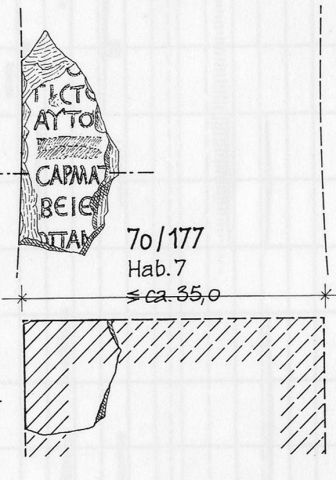
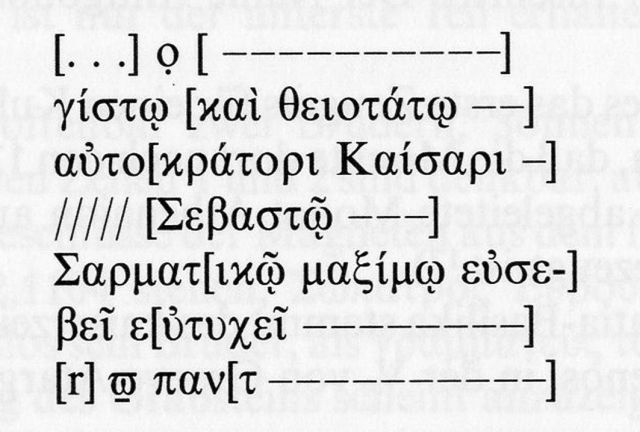
Inscription
[...]Ο̣[----------] / γίστῳ [καὶ θειοτάτῳ --] / αὐτο[κράτορι Καίσαρι-] /(4) /////[Σεβαστῷ ---] / Σαρματ[ικῷ μαξίμῶ εὐσε-] / βεῖ ε[ὐτυχεῖ --------] / [r] ω παν[τ----------]
Inscription translation
..to the most powerful and divine ... emperor Caesar ... Augustus ... most powerful victor over the Sarmatians, pious, fortunate, ... all(?)
Bibliography
- Supplementum Epigraphicum Graecum, , 37, 462
- Habicht, C., Neue Inschriften aus Demetrias, Demetrias V (Bakhuizen, S. C. et alii) , 269-306, Bonn 1987, pp. 274-5 no. 7
Discussion
INSCRIPTION
In seven lines:
[...]Ο̣[----------] / γίστῳ [καὶ θειοτάτῳ --] / αὐτο[κράτορι Καίσαρι-] /(4) /////[Σεβαστῷ ---] / Σαρματ[ικῷ μαξίμῶ εὐσε-] / βεῖ ε[ὐτυχεῖ --------] / [r] ω παν[τ----------]
..to the most powerful and divine ... emperor Caesar ... Augustus ... most powerful victor over the Sarmatians, pious, fortunate, ... all(?)
Letter height 1.8 cm.
DESCRIPTION (from Habicht 1987 and the published image)
Fragment of blue-greyish marble, broken on all sides except for a portion of the left margin; H 24.9, W 16.5, D 13.3 cm.
PROVENANCE AND LOCATION
The inscription was found in 1970 in the uppermost layer of debris in the baptisterium of the Damokratia-Basilica in Demetrias. It is now in the Demetrias excavation storerooms, inv. no. 1970/177.
HONORAND AND DATE
The honorand is an emperor (line 3) who took on the victor title of Sarmaticus (line 5). This can be either Commodus (180-92), Maximinus Thrax (235-8), Diocletian (284-305), Maximian (286-305), Constantius I (293-306), Galerius (293-311), Licinius (308-24), Constantine I (306-37), Constantius II (324-61) Constans (333-50), or Julian (361-3).
As Habicht 1987, 274 points out, the erasure of the imperial name in line 4 makes Commodus, Maximinus, Maximian, and Licinius more probable than the others. The vicinity of the victor title to the (erased) imperial name makes Maximian (Sarmaticus his second victor title) and Licinius (Sarmaticus his first title) more probable than Commodus (fourth title) and Maximinus (third title).
Cite: Last Statues of Antiquity, LSA-933 (Ulrich Gehn).