
LSA-934
Two fragments of a plaque, possibly from statue base, with dedication to Diocletian, Maximian and Constantius I, emperors. Malla (Creta). 293-305
Record details
Photographs
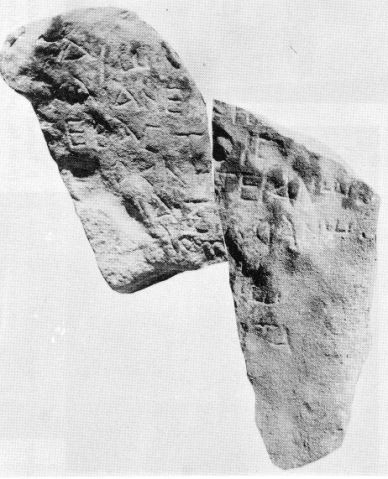
Inscription
Αἰων̣[είοις] / καὶ ἀνει[κ]ή̣[τοις] / Σεβαστο̣ῖς / [Δ]ειοκλ̣η̣τ̣ειανῷ /(5) [καὶ] Μαξ[ει]μ̣ιανῷ / [καὶ Κονστ]αν̣τίῳ / [τοῖς ἐπιφανεσ]τά/[τοις Καισάρσι].
Inscription translation
To the eternal and invincible Augusti Diocletian and Maximian and Constantius the most noble Caesars.
Bibliography
- Supplementum Epigraphicum Graecum, , 32, 900
Discussion
INSCRIPTION
In eight lines:
Αἰων̣[είοις] / καὶ ἀνει[κ]ή̣[τοις] / Σεβαστο̣ῖς / [Δ]ειοκλ̣η̣τ̣ειανῷ /(5) [καὶ] Μαξ[ει]μ̣ιανῷ / [καὶ Κονστ]αν̣τίῳ / [τοῖς ἐπιφανεσ]τά/[τοις Καισάρσι].
'To the eternal and invincible Augusti Diocletian and Maximian and Constantius the most noble Caesars'
We give the inscription in the reading of Supplementum Epigraphicum Graecum. The first editor Davaras proposed a slighlty modified reading of line 5:
[καὶ Μ]α̣[ξ̣ειμ]ι̣ανῷ̣
The inscription has been largely completed by analogy with another inscription from the same findspot, which it resembles strikingly in form, wording and lettering (LSA-949). Strangely the name of the second Caesar of the first tetrarchy, Galerius, styled in LSA-949 Μαξειμιανός (full name: C. Galerius Valerius Maximianus), is missing from the present inscription.
DESCRIPTION
Two adjoining fragments of a thick plaque of poros stone, with the remains of 7 lines of an honorific inscription. One fragment from the left side of the plaque preserves parts of 5 lines of the inscription, the other one from the right side preserves parts of 6 lines.
PROVENANCE/ LOCATION
The ancient city of Malla is only known from coins and inscriptions. It is located in Crete, between the modern villages of Christos and Malles (http://www.trismegistos.org/place/33287). The plaque was found in the region of the present day village of Anatoli.
HONORAND, AWARDER AND DATE
The inscription preserves the names of two Augusti and one Caesar of the first tetrarchy,and hence is datable to 293-305.
FURTHER DISCUSSION
With the name of the honorands in the dative and no named awarder, the inscription does not match two major criteria usually found on honorific statue bases. But there is a very similar dedication found in the same place (LSA-949), suggesting a group of tetrarchic statues. The formula for honorific inscriptions tends to disintegrate in Late Antiquity, and there is in Crete at least one further example for an imperial statue group, where all members of the imperial college are named in separate inscriptions (the Theodosian group set up by the governor Dositheus Oecumenius Asclepiodotus in front of the new praetorium in Gortyn, LSA-472, LSA-770, LSA-950). It is therefore possible that the present inscription, with the other monument from Malla (LSA-949), testifies to a statue group of the tetrachs in that town.
Discussion references
- Davaras, K., Kretikes epigraphes III, Archaiologike Ephemeris 1980, 1-42, Athens 1982, 25-6 no. 25 pl. 6d
Cite: Last Statues of Antiquity, LSA-934 (Ulrich Gehn).