
LSA-935
Crown of base for statue, with dedication to Valens and (almost certainly) Valentinian I, emperors. Aiane/Caesarea (Thessalia). 364-367
Record details
Photographs
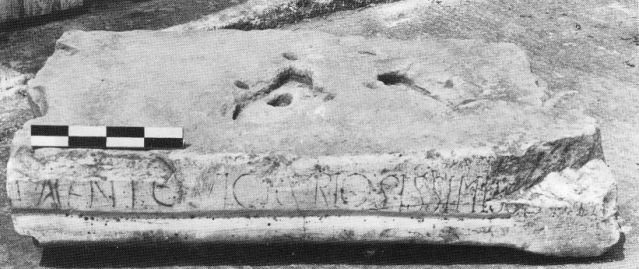
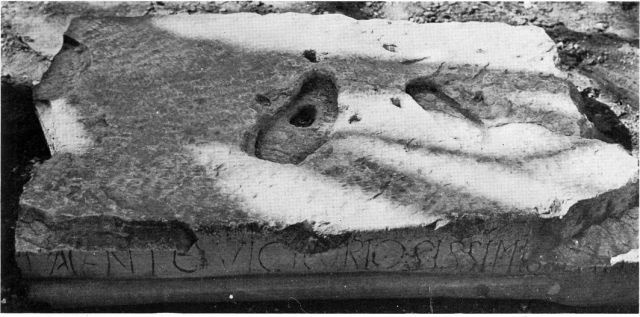
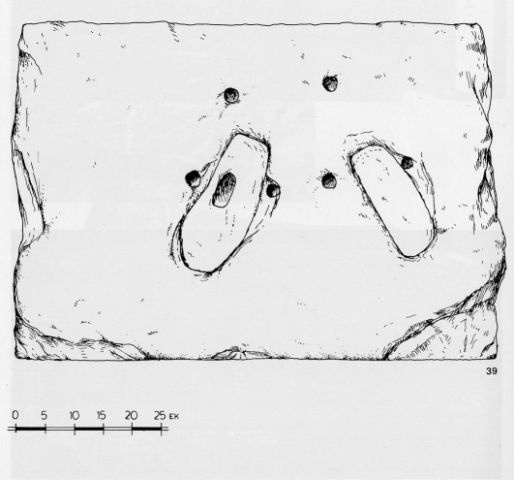
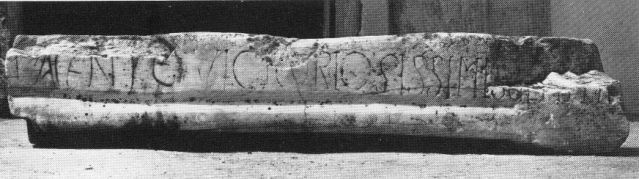
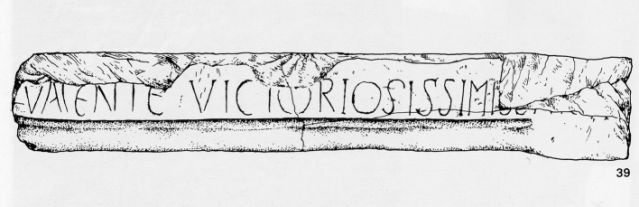
Inscription
[Impp(eratoribus) Caess(aribus) dd(ominis) nn(ostris) Fl(avio) Valentiniano et F]ḷ(avio) Vaḷenṭe vicṭoriosissimis ṣẹṃp̣eṛ [Augg(ustis)].
Inscription translation
To our Lords, the Emperors and Caesars Flavius Valentinianus and Flavius Valens, the most victorious eternal Augusti.
Bibliography
- Rizakis, Th. & G. Touratsoglou, Epigraphes apo Makedonias (Elimeia, Eordaia, Notia Lynkēstis, Orestis), Athens 1985, 53 no. 39 pl. 12, 84
Discussion
INSCRIPTION
In one line:
[Impp(eratoribus) Caess(aribus) dd(ominis) nn(ostris) Fl(avio) Valentiniano et F]ḷ(avio) Vaḷenṭe vicṭoriosissimis ṣẹṃp̣eṛ [Augg(ustis)].
'To our Lords, the Emperors and Caesars Flavius Valentinianus and Flavius Valens, the most victorious eternal Augusti'
We follow in our completion of the inscription the wording proposed by Rizakis & Touratsoglou (cf. also Feissel 1987). The inscription is dedicated to more than one emperor, as is clear from the plural 'victoriosissimis'. Whereas earlier scholars misread the first extant word as 'IAIENIE' assuming this be Greek, Rizakis & Touratsoglou 11985 recognized that it is in fact the name of the emperor Valens. The other emperor, whose name is not preserved, is therefore most likely to have been Valentinian I.
Letter height 4.7-5.4 cm.
DESCRIPTION (From Rizakis & Touratsoglou 1985 and the published photos)
Large rectangular marble plinth broken on left and right side. H 12 cm, W 83 cm, D 58 cm. On top, slightly off-centre to the right, there are imprints of two feet for the insertion of a bronze statue. Two small round holes left and right of both feet, two similar holes at the heels. At the break line on the left, there are traces of an imprint for a second bronze statue. The inscription is cut on a plain surface above a rod-shaped moulding. It once must have crowned a large base bearing the statues of the two emperors.
PROVENANCE/ LOCATION
The plinth was found in 1968 in the village of Kaisaria, in the region called 'Palaiokastro' (in the modern Nomos of Kozane, Macedonia), which is the site of the ancient city of Aiane (Caesarea). It is today in the Archaeological collection of Kaisaria, inv. no. 10.
HONORANDS AND DATE
Valens was emperor 364-78, his elder brother Valentinian I (much the most likely co-honorand) in 364-75. It is very unlikely that Valens (who ruled over the eastern provinces, including Aiane) would be named second in the inscription (as here), if the sole co-emperor being honoured was Gratian (his nephew, the son of Valentinian I, who succeeded his father in 375). The absence of Gratian in the dedication, on the other hand, dates the base earlier than 14 August 367, when Gratian was elevated to the rank of Caesar (Feissel 1987, 360 no. 2).
FURTHER DISCUSSION
We were not able to access K. E. Siambanopoulos, Αἰανή. Ἱστορία - τοπογραφία - ἀρχαιολογία, 1974, which discusses the base at p. 198 no. 8 and illustrates it on p. 199 (figs. 164-5).
Discussion references
- Andreiomenou, A., Archaiotetes kai Mnemeia Dytikes Makedonias, Archaiologikon Deltion 23 (1968) 345-51, Athena 1969, 350 Kaisareia no. 3 pl. 295 e
- Feissel, D. Inscriptions de Thessalie. Première Partie. Inscriptions du IVe au VIe siècle. (Inventaires en vue d'un recueil des inscriptions historiques de Byzance. IV. Inscriptions de Thessalie (à l'exception des Météores), Travaux et Mémoires 10, 357-67, Paris 1987, p. 360 no. 2
Cite: Last Statues of Antiquity, LSA-935 (Ulrich Gehn).