
LSA-937
Possible base for statue of Arcadius, emperor. Rhodos (Insulae). 383-395
Record details
Photographs
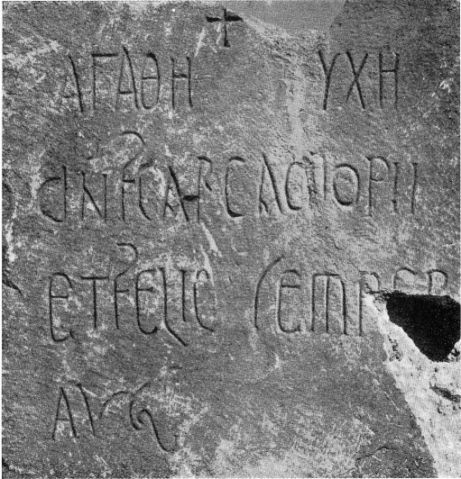
Inscription
Ἀγαθῇ [τ]ύχῃ / d(omini) n(ostri) Fl(avii) Arcadio (sic) pii / et felic(is) sempẹṛ / Aug(usti).
Inscription translation
To good fortune! Of our Lord Flavius, to Arcadius, of the pious and fortunate eternal Augustus.
Bibliography
- Šašel Kos, M., Inscriptiones Latinae in Graecia repertae. Additamenta ad CIL III , Faenza 1979, p. 24 no. 22
Discussion
INSCRIPTION
In four lines:
Ἀγαθῇ [τ]ύχῃ / d(omini) n(ostri) Fl(avii) Arcadio (sic) pii / et felic(is) sempẹṛ / Aug(usti).
'To good fortune! Of our Lord Flavius, to Arcadius, of the pious and fortunate eternal Augustus'.
Letter height not recorded.
Above the introductory formula is an inscribed cross. The lettering is decidedly odd, and not immediately recognizable as late-antique.
We give the inscription with the extensions proposed by Sasel Kos. Strange though the use of the genitive may appear, it is no odder than extending all the names and titles into the dative ( 'Ἀγαθῇ [τ]ύχῃ / d(omino) n(ostro) Fl(avio) Arcadio Pii (sic) / et felic(i) sempẹṛ / Aug(usto)'). That the genitive was intended is suggested by the very similar, and almost certainly contemporary, inscription to Theodosius I (LSA-936). Presumably the person who drafted this text had a weak grasp of Latin.
DESCRIPTION (from Jacopi 1932 and the published photo)
Rectangular block of marble once broken into two pieces, now reintegrated (Jacopi does not record whether the block is broken to right or left). H 120, W 65, D 48. A hole at the front right cuts the inscription, and is therefore later. Jacopi records a groove in the right face, perhaps to support an adjacent slab; a similar groove is recorded in the left side of the closely related block from the same findspot with the inscription to Theodosius I (LSA-936).
PROVENANCE AND CURRENT LOCATION
The base was found in 1929 in the square then called the 'Piazza dell' Arsenale'. It is now in the Archaeological Museum in Rhodos (without published inv. no.).
HONORAND AND DATE
Flavius Arcadius, elder son of Theodosius I, was Augustus from 383-408. Another, very similar inscription from the same findspot with a dedication to Theodosius himself (LSA-936) was almost certainly set up together with this one. The terminus ante quem is therefore given by the death of Theodosius in 395.
FURTHER DISCUSSION
While the shape and measurements of the block point to a statue base, the unusual formula using the genitive, and the absence of an awarder's name raise doubts. Jacopi 1932, 208 no. 44, interpreted the block as an architectural fragment. The genitive occurs on milestones (Feissel 1987), but this inscription comes from the city centre of Rhodos, and it was found together with another, similar inscription to Theodosius I (LSA-936). However, the deviant formula in this bilingual inscription may well have been caused by a poor knowledge of Latin in this Greek-speaking city (a similar case in Heraclea Pontica, Bithynia, in roughly the same period, LSA-528, LSA-529). We are unsure whether it was really a statue base, but have decided to keep the possibility open, and groups for Theodosian emperors are known from elsewhere (Stichel 1982).
Discussion references
- Feissel, D. Inscriptions de Thessalie. Première Partie. Inscriptions du IVe au VIe siècle. (Inventaires en vue d'un recueil des inscriptions historiques de Byzance. IV. Inscriptions de Thessalie (à l'exception des Météores), Travaux et Mémoires 10, 357-67, Paris 1987, p. 359 no. 1
- Jacopi, G., Nuove epigrafi dalle Sporadi meridionali, Clara Rhodos 2, 169-255, Rhodos 1932, 207-8 no. 43
- Stichel, R. H. W., Die römische Kaiserstatue am Ende der Antike, Roma 1982
Cite: Last Statues of Antiquity, LSA-937 (Ulrich Gehn).