
LSA-94
Base for statue of Claudius Illyrius, governor of Achaea. Athens, Acropolis. Late third century
Record details
Photographs
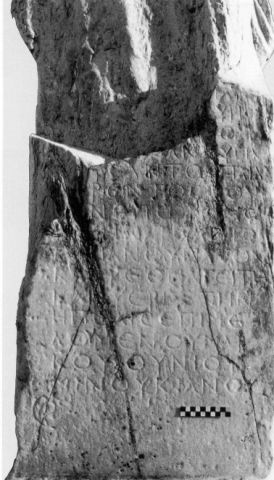
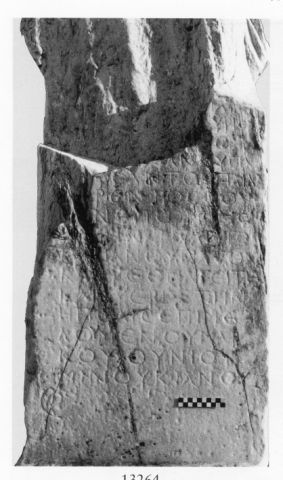
Inscription
[Τὸν λαμπρό]- / [τατον ἀνθύ]πατον / (3) [Κλαύδιον Ἰλ]λυριόν, / [ἔγγονον Λ]εοντι- / [κοῦ το]ῦ ἀνθυπα- / (6) [τε]ύσαντος, παῖδα / [Τ]ήρεντος τοῦ / [τὴ]ν ἐπώνυμον / (9) ἀρχὴν ἄρξαντος, / τὸν ἀνθύπατον / καὶ Ἀρεοπαγείτη[ν] / (12) καὶ ἐυεργέτην / ἡ πόλις, ἐπιμε- / λουμένου Μάρ-/ (15) κου Ἰουνίου / Μινουκιανοῦ. (ivy leaf)
Inscription translation
The city [set this up to] the governor (anthupatos) of clarissimus rank, Claudius Illyrius – grandson of Leonticus the former governor, son of Terens the former holder of the office of eponymous archon – governor, member of the Areopagus, and benefactor. Marcus Iunius Minucianus took charge.
Bibliography
- Inscriptiones Graecae, II/III 3690
- Inscriptiones Graecae, II/III(2) 13264
Discussion
INSCRIPTION
Originally in 16 lines, of which the first is now lost:
[Τὸν λαμπρό]- / [τατον ἀνθύ]πατον / (3) [Κλαύδιον Ἰλ]λυριόν, / [ἔγγονον Λ]εοντι- / [κοῦ το]ῦ ἀνθυπα- / (6) [τε]ύσαντος, παῖδα / [Τ]ήρεντος τοῦ / [τὴ]ν ἐπώνυμον / (9) ἀρχὴν ἄρξαντος, / τὸν ἀνθύπατον / καὶ Ἀρεοπαγείτη[ν] / (12) καὶ ἐυεργέτην / ἡ πόλις, ἐπιμε- / λουμένου Μάρ-/ (15) κου Ἰουνίου / Μινουκιανοῦ. (ivy leaf)
'The city [set this up to] the governor (anthupatos, proconsul) of clarissimus rank, Claudius Illyrius – grandson of Leonticus the former governor, son of Terens the former holder of the office of eponymous archon – governor, member of the Areopagus, and benefactor. Marcus Iunius Minucianus took charge.'
Where there are missing words, these can be completed with confidence from a second inscription set up to Illyrius by Minucianus, which uses exactly the same words (LSA-93).
DESCRIPTION (from Sironen 1997 and the published photo)
Tall rectangular base of whitish marble, decorated with mouldings on top and at bottom, partly broken away. The top of the epigraphic field is broken away and there are some later cracks in the inscribed face. Back side unfinished; imprints for the feet of a bronze statue on top.
PROVENANCE AND LOCATION
Preserved in situ on the Acropolis, northwest of the Erechtheion. National Museum no. Akrop. 13240.
As Deligiannakis 2010 points out, the Acropolis remained a favoured setting for honorary portrait dedications in late antiquity, 'on account of its association with Athens' glorious past but also its present, as a focal place of public ceremonial and traditional religion'.
HONORAND, AWARDER, AND DATE
Claudius Illyrius, an Athenian by birth, was awarded a second statue in Athens by the same Marcus Iunius Minucianus with exactly the same honorific inscription (LSA-93). A further statue to the same man was set up in Corinth (LSA-60). From another Athenian inscription (IG II/III 5199, Sironen 1994 no. 4), Illyrius is known to have rebuilt the Athenian walls after the Herulian incursion of 267. This building activity has long led to a mid 3rd century date for his governorship (PIR(2) p. 207 no. 892; Groag 1939, 94), apparently corroborated by the identity of the awarder (dated to the mid-3rd century by Traill 2003, 376 no. 654170; but see also Millar 1969, 17). However recent research now dates the wall "firmly ... in the reign of Probus (276-282) or slightly later" (Frantz 1988). This provides a date in the late 270s or the 280s for Claudius Illyrius. His governorship must have been held before Diocletian's provincial reforms, which downgraded the rank of the governor of Achaea to that of hegemon (Latin, praeses) - since Illyrius is described as anthupatos (Latin, 'proconsul') in the Athenian inscriptions. A date in the late 3rd century for our inscription today seems widely accepted (Millar 1969; Christol 1986, 177-182; Sironen 1994, 20 no. 2, 21-2 no. 4).
The dedication to Illyrius was awarded by the city of Athens. Marcus Iunius Minucianus who was charged with the execution of the decree was a local notable from an old Athenian family of sophists (rhetors) and historians. He was himself a sophist (professor of rhetorics) and author, and he held civic and priestly offices (Millar 1969, 16-17; see also LSA-93).
Discussion references
- Christol, M., Essai sur l'évolution des carrières sénatoriales dans la 2e moitié du IIIe siècle ap. J. C., Paris 1986, 177-182
- Deligiannakis, G., Late Antique Honorific Statuary from the province of Achaia, A.D. 300-600: A contribution to the topography and public culture of late antique Greece, Psaroudakes, K. & E. Sioumpara (eds.), Festschrift for Professor P.G. Themelis, Athens, 2010, 17-19
- Frantz, A., Late Antiquity A. D. 267 - 700: The Athenian Agora XXIV, Princeton 1988, 9-11
- Groag, E., Die Römischen Reichsbeamten von Achaia bis auf Diokletian (Schriften der Balkankommision, Antiquarische Abteilung IX), Wien & Leipzig 1939, 94
- Groag, E. & A. Stein, Prosopographia Imperii Romani Saec. I. II. III Pars II, Berlin & Leipzig 1936, Vol. II p. 207 no. 892;
- Millar, F., P. Herennius Dexippus: The Greek World and the Third-Century Invasions, Journal of Roman Studies 59, 12-29, London 1969, 17
- Sironen, E., The late Roman and early Byzantine inscriptions of Athens and Attica, Dissertation - University of Helsinki 1997, 60-2 no. 6
- Sironen, E. , 'Life and administration of late Roman Attica in the light of public inscriptions'
P. Castrén, Post-Herulian Athens : aspects of life and culture in Athens, A.D. 267-529 , Helsiniki 1994, 15-62, 20 no. 3 - Traill, J. S., Persons of Ancient Athens, Vol 12, M- to Moses, Toronto 2003, 376 no. 654170
Cite: Last Statues of Antiquity, LSA-94 (Ulrich Gehn).