
LSA-942
Dedication to an emperor, almost certainly from base for statue. Cos (Insulae). Late third to mid fourth century
Record details
Photographs
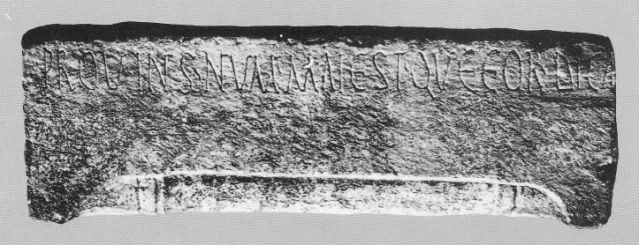

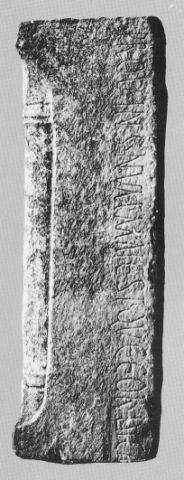
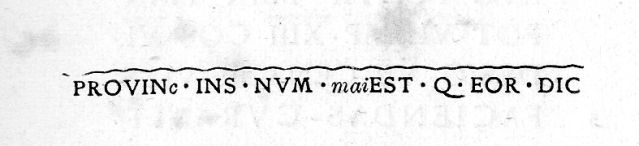
Inscription
---/ prov(inciae) Ins(ularum) num(ini) maiest(ati)que eor(um) dica(tissimus)
Inscription translation
... of the province of the Islands most dedicated to their divine spirit and majesty
Bibliography
- Segre, M., Iscrizioni di Cos, Roma 1993, p. 272 no. EV 363
Discussion
INSCRIPTION
---/ prov(inciae) Ins(ularum) num(ini) maiest(ati)que eor(um) dica(tissimus).
'... of the province of the Islands most dedicated to their divine spirit and majesty'.
The inscription preserves only the last line of a text which once probably included the names of various emperors (cf. '<b>their</b> divine spirit and majesty' in the inscription) and of the honorand. We have, with confidence, extended the first word to the genitive prov(inciae), rather than to Segre's prov(incia), assuming that it belongs to the awarder's title of governor (praeses) of the Islands (praeses provinciae Insularum), and the last word to 'dicatissimus, 'most dedicated', not to 'dicavit', 'he dedicated', since 'numini maiestatique eorum dicatissimus', 'most dedicated to their divine spirit and majesty', is a standard and very common formula to describe the loyalty of imperial officials.
Letter height 7 cm.
Mommsen in 1873 (CIL III 460) recorded an inscription on Cos (with no detail of the precise location) that read:
.... provin(ciae) Ins(ularum) num(ini) (mai)est(ati) q(ue) eor(um) dic(atissimus). Although there are variations, we suspect this is actually the same inscription.
DESCRIPTION (from the published photo)
Rectangular block of marble, used in post-Roman times to carve a small engaged colonnette. H 38, W 113, D 21. The surviving wording is typical of the end of a statue dedication, and the block comes, almost certainly, from the bottom of a statue base. The left edge may be original, since the inscription leaves a small space before it starts. No other edges are original, and most of the upper part of the block is missing, leaving only the last line of the inscription.
PROVENANCE/ LOCATION
The block was found in the castle of Cos (Segre 1993). There is no published record of its current location.
HONORAND, AWARDER AND DATE
The names of the honorands are lost, but the inscription uses a formula very common in the tetrarchic and Constantinian periods and it was therefore probably part of a dedication to various Tetrarchs, or perhaps Constantinian emperors. The letter forms are also typical of tetrarchic inscriptions, as E. Sironen has kindly informed us.
The awarder was probably a governor (praeses) of the Islands.
Discussion references
- Corpus Inscriptionum Latinarum; , III 460
Cite: Last Statues of Antiquity, LSA-942 (Ulrich Gehn).