
LSA-948
Base for statue of a tetrarchic emperor or Constantine I. Thasos (Insulae). 284-337
Record details
Photographs
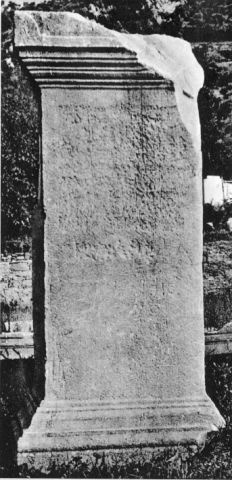
Inscription
τ̣ὸ̣ν̣ μ̣έ̣γ̣ισ̣τ̣ο̣ν̣ [καὶ] / [θ]ε̣ι̣ό̣τ̣α̣τ̣ο̣ν̣ / (5 lines illegible) / Καί[σαρα?] Λ[..Οὐα-] / λέριον --- / ἡ πόλις
Inscription translation
The city (set this up to) the most powerful and divine Caesar L... Valerius ...
Bibliography
- Dunant, C. & J. Pouilloux, Recherches sur l'Histoire et les cultes de Thasos. II. De 196 avant J.-C. jusqu'à la fin de l'Antiquité (Études Thasiennes V), Paris 1958, 190 no. 359
Discussion
INSCRIPTION
τ̣ὸ̣ν̣ μ̣έ̣γ̣ισ̣τ̣ο̣ν̣ [καὶ] / [θ]ε̣ι̣ό̣τ̣α̣τ̣ο̣ν̣ / (5 lines illegible) / Καί[σαρα?] Λ[..Οὐα-] / λέριον --- / ἡ πόλις
The city (set this up to) the most powerful and divine Caesar L... Valerius ...
We give the inscription, which is in large parts erased, in the reading of Dunant & Pouilloux.
DESCRIPTION (from Dunant & Pouilloux and the published photo)
Tall base of greyish marble, moulded at top and bottom. Mouldings broken at upper and lower right front side. Plinth decorated with acroteria in low relief, as still visible on the extant left top. Epigraphic field without frame. The inscribed text is largely erased.
PROVENANCE/ LOCATION
The base was discovered in 1951 in the medieval fortification on the Agora of Thasos. Now in the Thasos Museum, inv. no. 989.
HONORAND AND DATE
The introductory formula makes it certain that the honorand is an emperor. Of the imperial name, only -λέριον - -lerius has survived. If this is completed to Οὐαλέριον - Valerius, as proposed by Dunant & Pouilloux, almost all emperors of the tetrarchic era, including Constantine I and excluding only Maximian, are candidates, because Valerius was part of their names: Diocletian, Galerius, Constantius I, Severus, Licinius, Maximinus Daia, Constantine I, even Licinius Caesar. The successors of Constantine do not carry this nomen any more. The date must therefore range from Diocletian's elevation in 284 to Constantine I's death in 337.
Cite: Last Statues of Antiquity, LSA-948 (Ulrich Gehn).