
LSA-95
Base for statue of Aerarius Sosipatrus, priest. Eleusis (Achaea). Third to fourth century
Record details
Photographs
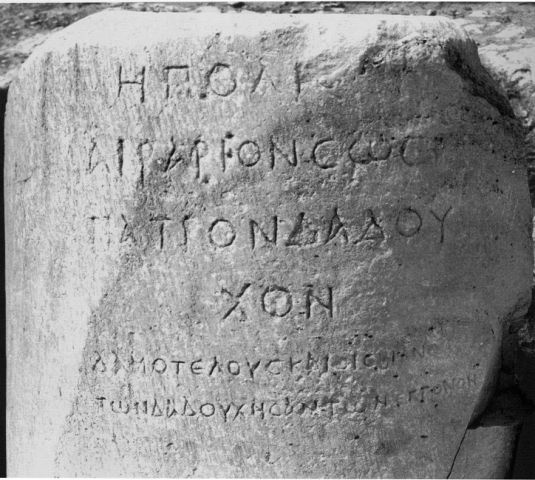
Inscription
ἡ πόλις / Αἰράριον Σωσί/πατρον, Δαδοῦ/χον, / Δαμοτέλους καὶ Θισβιανοῦ / τῶν δαδουχησάντων ἔγγονον.
Inscription translation
The city [set this up to] Aerarius Sosipatrus, the torchbearer (dadouchos), grandson of Damoteles and Thisbianus, the torchbearers.
Bibliography
- Inscriptiones Graecae, II/III 3715
- Inscriptiones Graecae, III,1, 732
Discussion
INSCRIPTION
In six lines:
ἡ πόλις / Αἰράριον Σωσί/πατρον, Δαδοῦ/χον, / Δαμοτέλους καὶ Θισβιανοῦ / τῶν δαδουχησάντων ἔγγονον.
'The city [set this up to] Aerarius Sosipatrus, the torchbearer (dadouchos), grandson of Damoteles and Thisbianus, the torchbearers.'
The letters in the last two lines, mentioning Sosipatrus' grandfathers, are much smaller than those of the principal dedication.
DESCRIPTION (from Clinton 2005 and the published photo)
Cylindrical base of white ('Pentelic') marble, broken at the back: H 100, diameter 70 cm.
PROVENANCE AND LOCATION
The base is now situated 'within the sanctuary on the right side of the processional path as you ascend, in the area labelled 21 on the plan' (Clinton 2005). Clinton does not speculate about its original location, but refers to two scholars of the 19th century (Chandler and Lénormant) who saw it in a house beside the royal street to Megara and Thebes.
HONORAND AND DATE
Our honorand was a torchbearer (dadouchos, or daduch) at Eleusis, and the grandson of two further daduchs. This prestigious priestly office was held by members of illustrious Athenian families, and is attested as late as the 5th century (Follet 1976, 281, n. 4). His gentilicium, Aerarius, has led to questions, because, although it is attested in Athens, this is 'in the wrong milieu to be absolutely convincing as the nomen of an aristocratic daduchic house' (Oliver 1950). However, no convincing alternatives for the reading are available. Sosipatrus Aerarius is otherwise unknown (Traill 2007).
A date in the late 3rd/4th century for our inscription was proposed by IG because of the poor lettering; while Follet 1976 dates our torchbearer to the third quarter of the 3rd century on prosopographical grounds. Clinton 1974 dates the lettering to the late 3rd, or even the 4th century; while Clinton 2005 argues for the second half of the 3rd century.
FURTHER DISCUSSION
Portrait heads of priests survive from late-antique Greece, and not only from Athens and Eleusis. From Eleusis itself there is a priestly head of the 'Iamblichus-type' (LSA-116).
Discussion references
- Clinton, K., Eleusis. The Inscriptions on Stone. Documents of the Sanctuary of the two Goddesses and Public Documents of the Deme, Athens 2005, 483 no. 654
- Clinton, K., The Sacred Officials of the Eleusinian Mysteries (TAPS 64.3), Philadelphia 1974, p. 64 no. 29
- Follet, S., Athènes au IIe et au IIIe siècle. Études chronologiques et prosopographiques, Paris 1976, 281
- Oliver, J. H., Three Attic inscriptions concerning the Emperor Commodus, American Journal of Philology 71, 1950, 170-179, 174
- Traill, J. S., Persons of Ancient Athens, Volume 16, Sym- to Tychonides, Toronto 2007, 139 no. 862980
Cite: Last Statues of Antiquity, LSA-95 (Ulrich Gehn).