
LSA-950
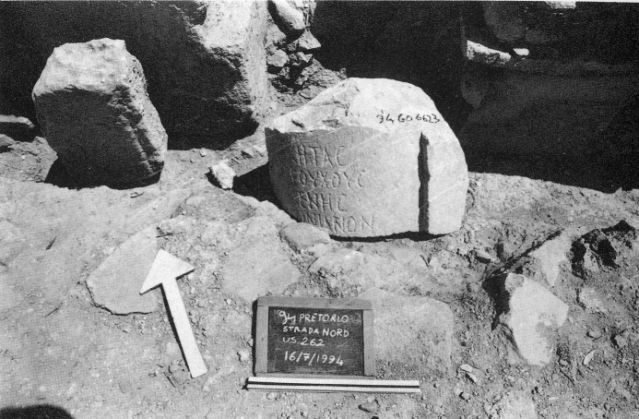
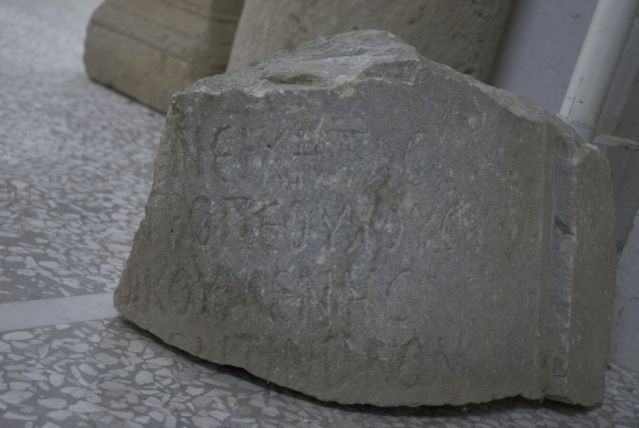
Semicolumnar block, probably base for statue, with dedication to Gratian, Valentinian I and Theodosius I, emperors. Gortyna (Creta). 382-383
Record details
Photographs
Inscription
[Τοὺς ἀηττήτους νεικ]ητὰς / [καὶ αἰωνίους τροπ]εούχους / [δεσπότας τῆς οἰκουμ]ένης / [Γρατινόν, Βαλεν]τινιανὸν / [καὶ Θεοδόσιον εὐσεβεῖς σεβαστοὺς] / ---------------------
Inscription translation
(... set this up to) the invincible victors and eternally triumphant Lords of the world Gratian, Valentinian, and Theodosius the pious Augusti ...
Bibliography
- Supplementum epigraphicum graecum, Amsterdam 1923-, 45, 1292
Discussion
INSCRIPTION
Partly preserved in four lines:
[Τοὺς ἀηττήτους νεικ]ητὰς / [καὶ αἰωνίους τροπ]εούχους / [δεσπότας τῆς οἰκουμ]ένης /(4) [Γρατινόν, Βαλεν]τινιανὸν / [καὶ Θεοδόσιον εὐσεβεῖς σεβαστοὺς] / --------------------- .
'(... set this up to) the invincible victors and eternally triumphant Lords of the world Gratian, Valentinian, and Theodosius the pious Augusti ...'.
The inscription preserves the right end of four lines of a dedicatory inscription, first published by Di Vita 1995, 474-6 fig. 72. We give the reading of SEG 45 with a slightly modified reading in line 2 (ε is visible on the published photo, justifying Chaniotis in SEG). The inscription preserves the imperial name Valentinianus, which must be Valentinian II. It is clearly one of three dedications to the emperors Gratian, Valentinian II, and Theodosius I, set up by the governor (consularis) of Crete Oecumenius Dositheus Asclepiodotus (the other two being LSA-472, LSA-770) (Di Vita 1990, 474-5). The text can be restored, according to the most complete of the three (LSA-472) as follows:
τοὺς ἀηττήτους νεικητὰς / καὶ αἰωνίους τροπεούχους / δεσπότας τῆς οἰκουμένης / Γρατιανόν () Βαλλεντινιανὸν / καὶ Θεοδόσιον ευσεβεῖς σεβαστοὺς, / πρὸ τῆς εἰσόδου τοῦ καινοῦ / πρετωρίου τοῦ ἐκ θεμελίων / κατασκευαζομένου, / Οἰκουμένιος Δωσίθεος / Ἀσκληπιόδοτος ὁ λαμπρό- / τατος ὑπατικὸς τῆς Κρη- / τῶν ἐπαρχείας καθίδρυσεν καθοσιουμένος τῇ / αὐτῶν εὐσεβίᾳ.
'Oecumenius Dositheus Asclepiodotus the governor (consularis) of the province of Creta of clarissimus rank set (this) up the invincible victors and eternally triumphant Lords of the world Gratian, Valentinian, and Theodosius the pious Augusti, in front of the entrance of the new praetorium which he built from its foundations, devoted to their piety'.
DESCRIPTION (from the published photo)
Fragment of an engaged semi-columnar block of local grey marble, broken at top, bottom, left and back sides. The inscription is on the convex surface of which only a part of the right side remains.
PROVENANCE/ LOCATION
Found 1991 used as a building block in a wall of the Byzantine houses in the north portico of the so-called 'Strada Nord', north of the praetorium in Gortyn (Di Vita 1995, 474, De Tommaso 2000, 343). The fragment has the excavation inventory no. 94GO6623. There is no published record of its present location.
HONORANDS, AWARDER AND DATE
From the better preserved inscriptions of the same series (LSA-472, LSA-770) it is clear that the dedication was to the three emperors Gratian, Valentinian II, and Theodosius I, awarded by the governor of Crete Oecumenius Dositheus Asclepiodotus (PLRE I, 115 Oecumenius Dositheus Asclepiodotus 2). These constitute a set of semicolumnar blocks of identical form, size and material. Three of them, with their imperial dedications, are thereby datable between the accession of Theodosius in 379 and Gratian's death in 383 (LSA-472, LSA-770, LSA-950). However, the governorship of the awarder, himself honoured on an identical base (LSA-774), is reliably datable to 382-3.
Again from the better preserved inscriptions (LSA-472, LSA-770) the awarder Oecumenius Dositheus Asclepiodotus, governor (consularis) of Creta, is known (PLRE I, 115 Oecumenius Dositheus Asclepiodotus 2). Asclepiodotus is commemorated in no less than eleven inscriptions in Crete. He was honoured with a statue in Olous (LSA-792); in Gortyn, a set of 10 statue bases for leading members of the senatorial aristocracy of the city of Rome have been found (LSA-773, LSA-775, LSA-776, LSA-777, LSA-778, LSA-779, LSA-780, LSA-781, LSA-782, LSA-783), on seven of which Asclepiodotus' name as awarder is preserved (LSA-775, LSA-776, LSA-777, LSA-778, LSA-779, LSA-780, LSA-781). Last but not least, the group of dedications to the emperors of which our inscription forms a part was completed by a statue of the governor himself awarded by members of the local aristocracy (LSA-774).
FURTHER DISCUSSION
The remains of four semi-columnar blocks of identical size and material, with their dedicatory inscriptions on the convex face, are preserved in Gortyn (LSA-472, LSA-770, LSA-774, LSA-950). Three of these carry dedications to the emperors Gratian, Valentinian II, and Theodosius I by the governor Oecumenius Dositheus Asclepiodotus (LSA-472, LSA-770, LSA-950), the fourth a dedication to the governor himself by local men (LSA-774). From the inscriptions LSA-472, LSA-770 it is evident that the bases were set up at the entrance of the new praetorium, which our governor Asclepiodotus had built 'from its foundations'. The dedicatory inscription to the governor himself (LSA-774) has a comparable phrase, stating that it was set up 'by Dike' (goddess of Justice) - παρὰ τὴν Δίκην - alluding to the place where justice was administered, hence the praetorium. Archaeological evidence suggests that Asclepiodotus' work was in fact a major repair, perhaps after damage in the earthquake of 365 (De Tommaso 2000, 342). The four semicolumns with inscriptions certainly decorated the new monumental entrance to the praetorium; they formed part of the four pillars which divided the entrance into three arches (De Tommaso 2000, 345).
De Tommaso assumes that the bases did not carry statues (De Tommaso 2000, 346 n. 65, and his reconstruction figs. 51, 52, the latter reproduced here as image no. 1). However the formula, using the accusative for the honorand and naming the awarder, is typical of a statue dedication, and we believe that three of the semi-columns (LSA-472, LSA-770 and LSA-950) once carried the statue of one of the emperors mentioned in the dedicatory texts, while a fourth carried a statue of Asclepiodotus himself.
Discussion references
- Daux, G. & Salac, A., Inscriptions depuis le Trésor des Athéniens jusque'aux Bases de Gélon (Fouilles de Delphes III iii), Paris 1932
- De Tommaso, G., Il Settore B: La Basilica del Pretorio. Fase B6 = Fase costruttiva IX (ultimo venticinquennio del IV sec. d.C.), Gortina V.1. Lo Scavo del Pretorio (1989-1995) - Vol. V. 1* - , 337-48, Padova 2000
- Jones, A. H. M. et al., The Prosopography of the Later Roman Empire. Vol. I 260-395, Cambridge et al. 1971 (1975)
Cite: Last Statues of Antiquity, LSA-950 (Francesca Bigi - Ignazio Tantillo - Ulrich Gehn).