
LSA-951
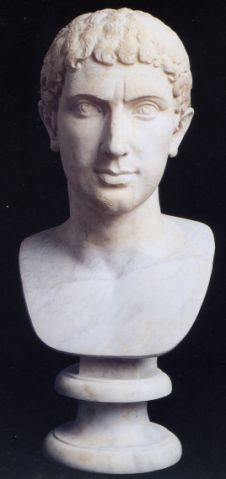
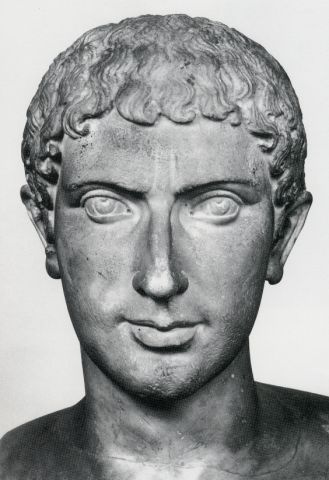
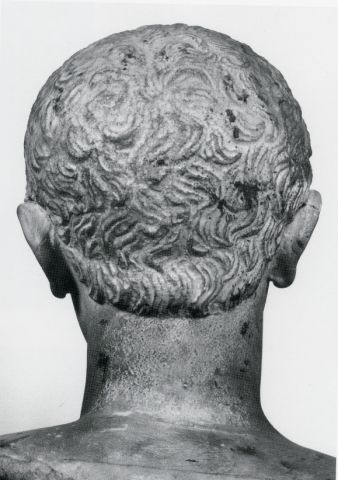
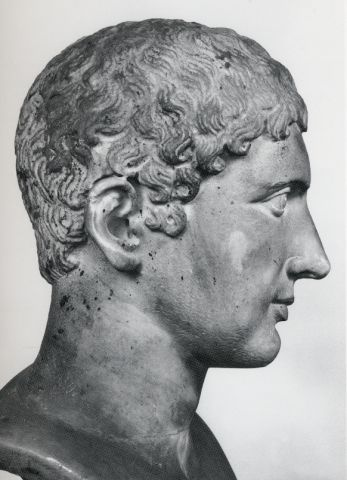
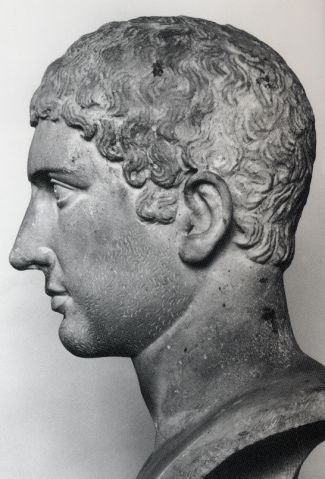
Portrait head of man with long face and light beard. From Italy. Late fourth to early fifth century.
Record details
Photographs
Bibliography
- Fittschen, K., P. Zanker, and P. Cain, Katalog der Porträts in den Capitolischen Museen und den anderen kommunalen Sammlungen der Stadt Rom. Band II. Die männliche Privatporträts, Berlin 2010, 183-5, no. 181, pl. 225 (c. 400)
Discussion
DESCRIPTION (Object)
Over life-size head mounted on modern bust. H: 31, H (chin to crown): 26.5 cm. Luni white marble.
The bust, the tip of the nose, and the edges of the ears are restoration.
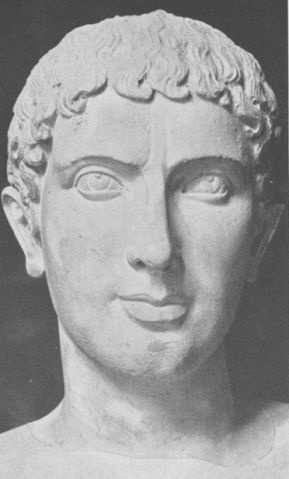
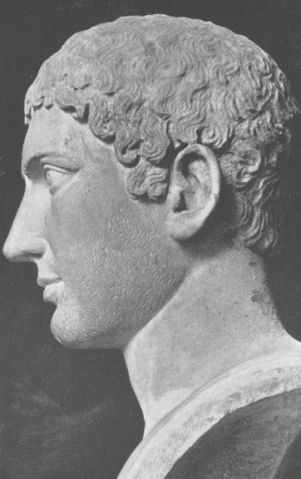
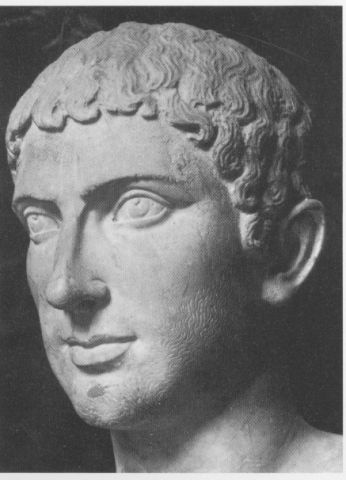
The drill has been used sparingly in the hair around the ears and in a few curls over the brow. The remainder of the hair, the eyebrows, and fine facial hair on the cheeks and upper lip are indicated with careful chisel work. The iris is indicated by an engraved half-circle made by a flat chisel. The pupil is also defined by a curving line of the flat chisel that widens near the bottom, giving it almost a crescent-shape. There is a single drill hole at each inner canthus.
PROVENANCE
Rome or its environs.
DESCRIPTION (Subject)
The head depicts a young man with a long face, curly hair, and light growth of facial hair. The hair, which comes forward, is rendered in thick but flat S-shaped locks which end in tight curls over the brow. Individual strands have been carefully engraved but the uniform flatness of the locks makes the hair sit like cap. In the fringe there is a distinctive parting of the locks over the centre of the right eye. The three-dimensional sideburns yield to a finely engraved beard and moustache.
The face is long oval with elegantly stylized features. The brow has two sharp vertical creases above the nose. The eyebrows are fine ridges with a low arch. The ridge of the nose is also narrow. The mouth has upturned corners which give the impression of a smile. The philtrum is distinctly defined and creates a dip in the upper lip; the lower lip is full. The chin is deep and projecting.
DATE AND HONORAND
In terms of fashion and even physiognomy, this portrait recalls a portrait now in Munich and one on a togate statue in Rome,LSA-906 and LSA-907. L’Orange grouped all of these portraits under the heading of the ‘subtle style’ which he associated with the Theodosian period. This assessment has been mainly accepted with a slight tendency to place this portrait in the earlier fifth century rather than the late fourth (Wünsche and Meischner).
Calza attempted on the basis of numismatic evidence to identify the portrait as Nepotianus, a short-lived usurper of the Constantinian family, in 350.
Discussion references
- Calza, R., Iconografia Romana Imperiale. Da Carausio a Giuliano (287-363 d. C.), Rome 1972, 350-51, no. 247, pl. 119, 436-7 (Nepotianus)
- Ensoli, S. and E. La Rocca (eds.), Aurea Roma: dalla città pagana alla città cristiana, Roma 2000, 549-550, no. 202 (R. Wunsche: ca. 410)
- L'Orange, H. P., Das spätantike Herrscherbild von Diokletian bis zu den Konstantin-Söhnen, 284-361 n. Chr. Das Römische Herrscherbild. III. Abteilung ; Bd. 4 , Berlin 1984, 140 (private, not Nepotianus)
- L'Orange, H. P., Studien zur Geschichte des spätantiken Porträts, Oslo 1933, 75, 143, no. 103, figs. 197-8
- Meischner, J., 'Das Porträt der theodosianischen Epoche II (400 bis 460 n. Chr.),' , Jahrbuch des Deutschen Archäologischen Instituts, 106 (1991), 385-407, 401-402, pl. 93.3
Cite: Last Statues of Antiquity, LSA-951 (J. Lenaghan).