
LSA-952
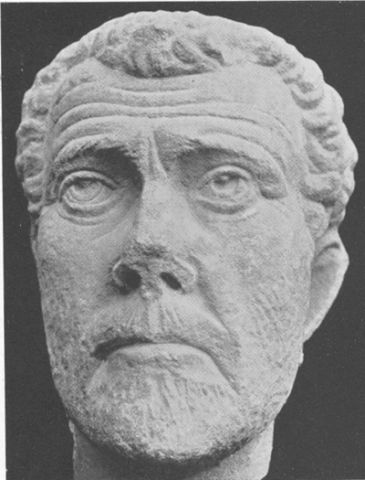
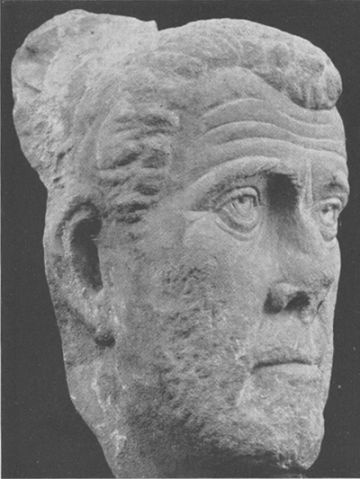
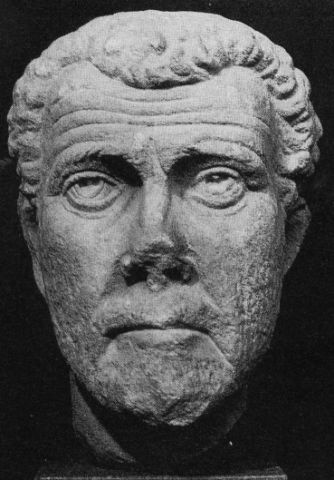
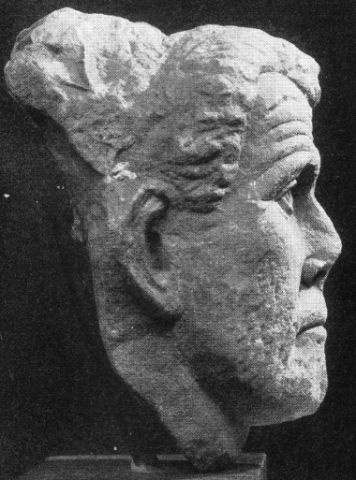
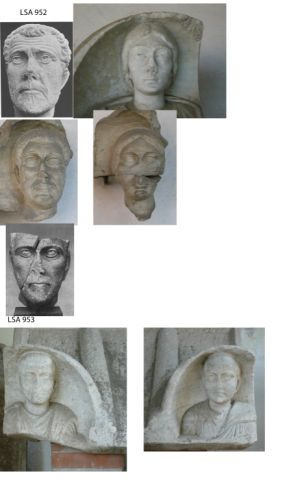
Portrait of man with short hair and beard from sarcophagus lid? Aquileia (Venetia et Histria). Fourth century.
Record details
Photographs
Bibliography
- Scrinari, V. S. M., Museo archeologico di Aquileia. Catalogo delle sculture romane, Rome 1972, 73, no. 216 (second half of 4th c.)
Discussion
DESCRIPTION (Object)
Life-size head attached to background. H: 27 cm. Marble.
The head seems to have broken through the neck. At the back proper right side is a fragment of the background to which the head was attached. The tip of the nose is broken.
The hair is worked with a flat chisel. It appears to be defined only around the face from the ears forward. The irises are fine engraved lines. The pupils are drilled, broad and flat U-shapes.
PROVENANCE
Aquileia.
DESCRIPTION (Subject)
The head shows a mature man who turns to his right. He has a slim face with a tall and much-lined brow. Narrow vertical lines rise up over the nose, and there are deep creases under and at the corners of the eyes. There are also creases under the eyes. He has a hooked nose and a deep chin.
His hair is thick and combed forward on to the brow and temples. It recedes significantly at each corner of the brow. The ends of the locks bend. He wears a short beard and moustache.
MONUMENT
The head probably belonged to the lid of a sarcophagus. It is similar to other portraits at Aquileia that are life-size busts set into an acroterion on the lid of a sarcophagus. In one sarcophagus lid in the courtyard of the Museum one acroterion shows a man dressed in a chlamys and the other acroterion has a man in a garment that is closest to the Theodisian toga. They are both short-haired and clean-shaven. The toga and the clean-shave suggest a fourth century date. In another similarly-conceived sarcophagus, there is a man in one acroterion and a woman in another; he wears short hair and a beard and she wears a centrally-parted hairstyle that covers her ears. In a third example only one acroterion is preserved, and it shows a woman with a centrally-parted hairstyle that covers her ears. Her eyes are rendered in the exact same manner as the portrait in discussion here.
DATE
The date is difficult to judge. L’Orange believed that the combed forward hairstyle and short-beard was that of the early fifth century, essentially that which is seen on the Obelisk of Theodosius and in portraits such as Oecumenius LSA-150.
L’Orange does not consider the fact that this portrait head probably comes from a sarcophagus such as those mentioned above. The sarcophagi seem to me to date to the fourth century. The women follow a fashion which is probably best understood as uninfluenced by metropolitan trends; it appears in other provincial portraits of this period (compare for example LSA-1001). Thus, although the shape of their hair vaguely recalls that of Faustina the Younger or Julia Domna, the technical cutting of their eyes, the short hair and beard styles of their partners, and the clothing of their partners makes a date before the end of the third century unlikely.
In the case of this head the fashion style brings to mind the portrait of Caius Caelius Saturninus signo Dogmatius (LSA-903), dated between 325 and 335.
Scrinari also believes that L’Orange’s date is too late and puts this portrait in the second half of the fourth century.
Discussion references
- L'Orange, H. P., Studien zur Geschichte des spätantiken Porträts, Oslo 1933, 82, 145, no. 109, figs. 206 and 208 (5th c.)
Cite: Last Statues of Antiquity, LSA-952 (J. Lenaghan).