
LSA-955
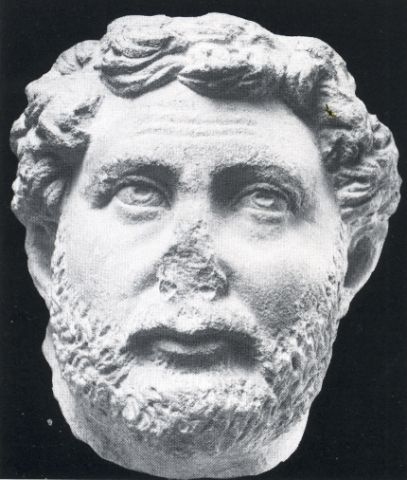
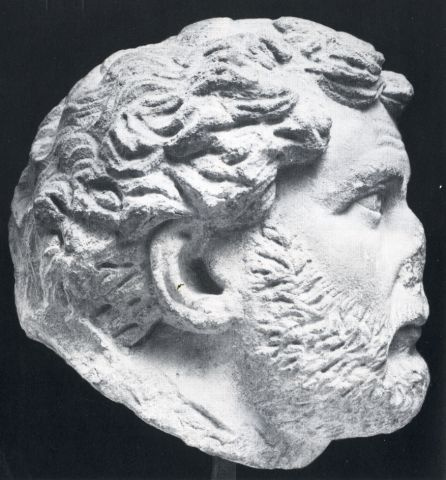
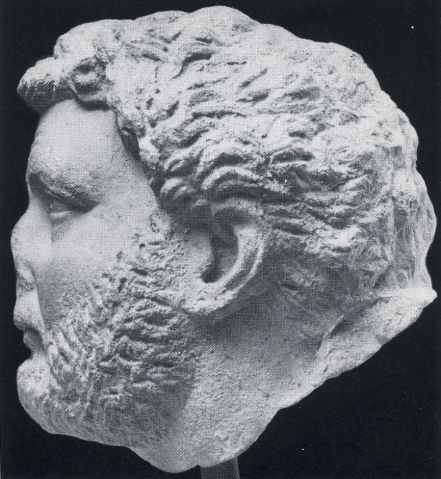
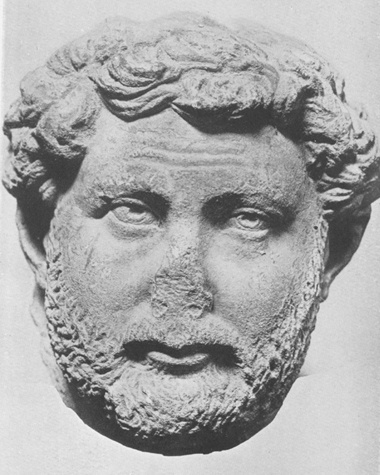
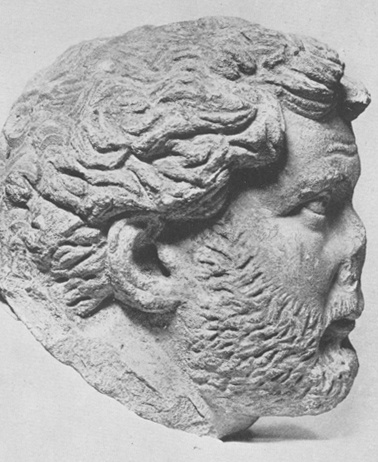
Portrait head of full-faced man with thick wavy hair and short beard. From Italy. Late fourth century?
Record details
Photographs
Bibliography
- Giuliano, A. (ed.), Museo Nazionale Romano. Le Sculture I,9. Magazzini. I Ritratti. Parte II, Rome 1988, 425-7, no. R324
Discussion
DESCRIPTION (Object)
Over life-size head. H: 27.5 cm. Marble
The head has broken from its supporting element diagonally from below the juncture of the neck and chin up to the nape of the neck. The tip of the nose is missing.
The break at the neck has surprising depth. In part this is because the back of the neck has not been fully worked out of the marble. The back and top of the head have been only roughly worked out.
The hair around has been crudely worked over with a drill. There is also some irregular drill work in the beard. It is possibly secondary. Both hair and beard also show flat chisel work. The iris is almost three-quarters of a circle and is engraved with a flat chisel. The pupils fill the width of the iris and have been drilled out.
PROVENANCE
Unknown.
DESCRIPTION (Subject)
The portrait shows a mature man with thick hair and a full beard and moustache. The hair is brushed forward in large unruly locks. Over the outer corner and inner corners of the right eye the locks part and sweep in large horizontal curves across the brow. Over the left eye the locks seem to curl upwards.
There are three creases across the brow. The face is full with round cheeks. The eyes are not especially large but do have distinctive downward-pointing inner canthi. There are also lines beneath them. The nose is deeply indented at its root. The upper lip has a pronounced central overhang. The lower lip is full. The chin projects.
DATE AND HONORAND
The portrait head is not easy to date. The hairstyle seems early Antonine. The eyes however seem too heavily marked for this date, and the drill work in the beard too schematic.
Thus, von Sydow placed in the early third century. Bonicatti wished to see this head and two others, (one now in Oslo LSA-954 and another found in Ostia at the Via del Santuario di Iside in 1938) as the same man. Felleti Maj saw this as an example of early fifth century portraiture. (This might now be better emended to late fourth century: see for example, the portrait of Oecumenius LSA-150.) Von Heintze considered it to be a late-antique version of Hadrian, which however Wegner contested.
It seems to me that the head is more likely to belong to the second or third century. However, I do not entirely exclude that it may have been lightly re-worked for a second use. This second use may have been in the third century or the late fourth; that is, an early Antonine portrait re-used in the Severan period or re-used in the fourth.
Discussion references
- L'Orange, H. P., Studien zur Geschichte des spätantiken Porträts, Oslo 1933, 83, 146, no. 113, figs. 214-15
- Von Sydow, W., Zur Kunstgeschichte des spätantike Porträts im 4. Jahrhundert. n. Chr, Bonn 1969, 156 (early third century)
Cite: Last Statues of Antiquity, LSA-955 (J. Lenaghan).