
LSA-96
Lost inscribed honorific herm for unknown man from city-quarter of Melite. Athens, Acropolis. Fourth century?
Record details
Photographs
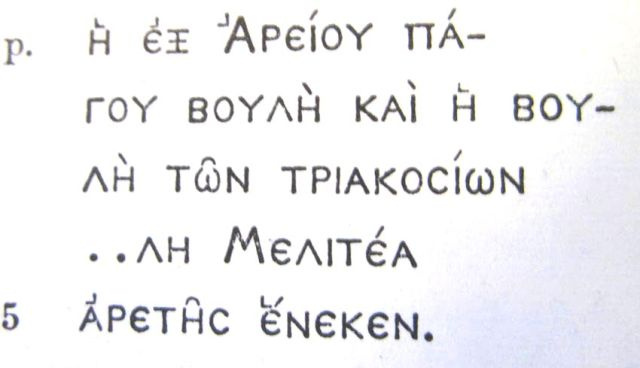
Inscription
ἡ ἐξ Ἀρείου πά/γου βουλὴ καὶ ἡ βου/λὴ τῶν τριακοσίων/ [--]λη Μελιτέα/ ἀρετης ἕνεκεν
Inscription translation
The council of the Areopagus and the council of the 300 members (honour) [---]les from the Deme of Melite, for his merits
Bibliography
- Inscriptiones Graecae, II/III 3716
- Inscriptiones Graecae, II/III(2) no. 13279
Discussion
INSCRIPTION
In five lines:
ἡ ἐξ Ἀρείου πά/γου βουλὴ καὶ ἡ βου/λὴ τῶν τριακοσίων/[--]λη Μελιτέα/ ἀρετης ἕνεκεν
'The council of the Areopagus and the council of the 300 members [to] ...les from the city-quarter (deme) of Melite, for his merits.'
DESCRIPTION (from Pittakes - see below 'Further Discussion')
The only available information is that the inscription was on a herm.
PROVENANCE AND LOCATION
Allegedly from the northern slope of the Acropolis, near the Aglaurion. Now lost.
HONORAND, AWARDER, AND DATE
About the honorand, whose name is only very partially preserved, nothing is known except that he was a citizen of Athens, from the deme of Melite.
The council had undergone several changes in number during the Roman period and was reduced to 300 members by the fourth century (Geagan 1967, 74), as is testified to by the honorific inscription to the governor Rufius Festus (LSA-103) dated to the second half of the 4th century. This is the only (rather weak) indication of a late date for our inscription. Against it are the naming of the honorand's deme, unusual after the 3rd century (Sironen 1997, 76), and the laconic prose form of the inscription (again unusual, though not unheard of, in the 4th century; see below, 'Further Discussion').
FURTHER DISCUSSION
Published by K. S. Pittakes, L'Ancienne Athènes ou la description des antiquités d'Athènes et de ses environs, Athens 1835 p. 158 and 495. As Sironen 1997, 76 puts it, ' this lost text provides more problems than information'. Pittakes is notorious for forgeries and the herm was already lost, when Dittenberger published it as IG III 719 in 1878. Furthermore, the two versions given by Pittakes (on pp. 158 and 495 respectively) differ somewhat.
Although there are doubts about the very existence, and the date, of our herm, it is true that herms were used to honour benefactors in late antique Athens, as shown by the monument for Iamblichus (LSA-135) and a monument set up for the local notable and historian Publius Herennius Dexippus, in the 270s (IG II/III 3670).
Discussion references
- Inscriptiones Graecae, II/III 3670
- Geagan, D. J., The Athenian Constitution after Sulla (Hesperia supplement XII), Princeton 1967
- Sironen, E., The late Roman and early Byzantine inscriptions of Athens and Attica, Dissertation - University of Helsinki 1997, 75-6 no. 17
- Sironen, E. , 'Life and administration of late Roman Attica in the light of public inscriptions'
P. Castrén, Post-Herulian Athens : aspects of life and culture in Athens, A.D. 267-529 , Helsiniki 1994, 15-62, 34-5 no. 18
Cite: Last Statues of Antiquity, LSA-96 (Ulrich Gehn).