
LSA-961
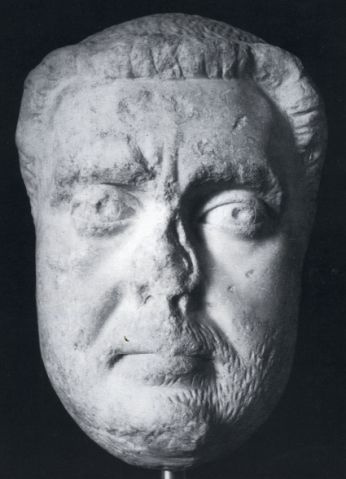
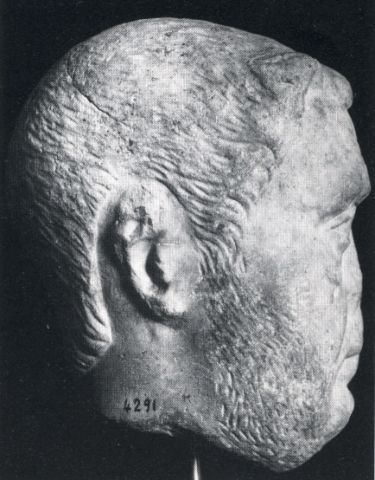
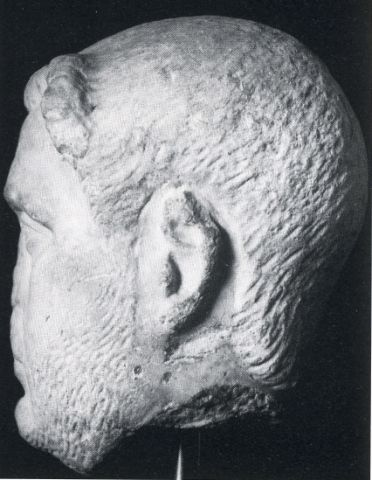
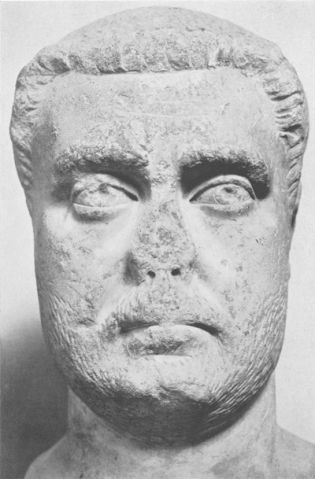
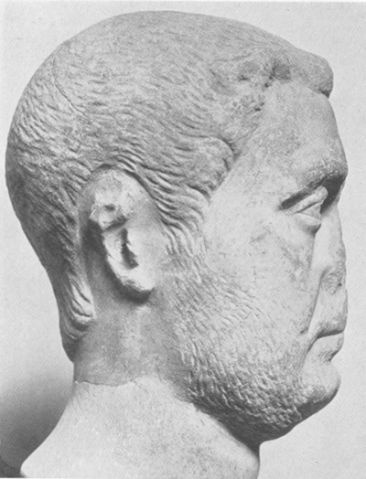
Portrait head of full-faced man with short hair and stubble beard. From Italy. Late fourth to early fifth century.
Record details
Photographs
Bibliography
- Giuliano, A. (ed.), Museo Nazionale Romano. Le Sculture I,9. Magazzini. I Ritratti. Parte II, Rome 1988, 427-8, no. R325
Discussion
DESCRIPTION (Object)
Life-size head. H: 24 cm. Marble
The head has been broken above the neck. Missing are the neck, the outer shells of both ears, and the nose. The eyebrows, lips, and chin are chipped. The back left side of the head appears to be abraded.
The head has been reworked from an earlier head, probably a first century portrait. The hair is distinctly separate from the skin around the ears which is characteristic of Julio-Claudian portraits. Here, the originally longer hair has been cut down and smoothed into a dome shape at the top and back of the head. A flat chisel has been used to render hair on the sides and back of the head. The hair over the brow has greater volume; presumably more of the hair of the original portrait was left here, and almost vertical slashes of the flat chisel define the locks.
A flat chisel is also used in the cheeks to engrave a short beard. A fine flat chisel line defines three-quarters of a circle which constitutes the iris. The pupil is a large hollowed area within the iris.
PROVENANCE
There is no recorded provenance.
DESCRIPTION (Subject)
The head, re-cut from an earlier work, depicts an older man with a tall and broad head. He wears a short beard, and his hair is brushed forward and stands up between the temples.
His tall brow is marked by vertical lines of contraction that stem from the root of the nose. The full face is modelled and has deep naso-labial folds. The mouth is thin-lipped and tightly closed. The chin is small and rounded. The eyes have heavy upper lids but are not especially large, and the eyebrows do not follow a high arch.
DATE
The head belongs with a group portraits (for example, LSA-380, LSA-960, LSA-704, and LSA-1721) that show a similar physiognomy and fashion style. They are generally dated to the end of the fourth century or early fifth century because of the appearance of similar styles on the Obelisk of Theodosius in Istanbul.
Technically this head resembles a portrait of an Empress (LSA-406) from Rome. They share an similar workmanship of the eyes, mouth, and flesh. Unfortunately that female head is also without a fixed date.
Discussion references
- L'Orange, H. P., Studien zur Geschichte des spätantiken Porträts, Oslo 1933, 87, 149, no. 122, figs. 228 and 230
Cite: Last Statues of Antiquity, LSA-961 (J. Lenaghan).