
LSA-97
Lost base for statue of Diocletian, emperor. Athens (Achaea). 284-290
Record details
Photographs
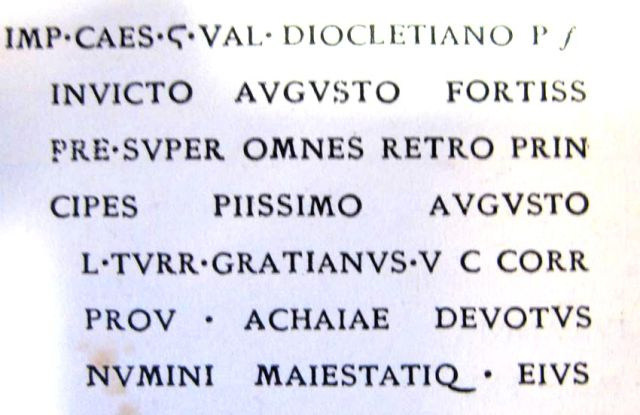
Inscription
Imp(eratori) Caes(ari) G(aio) Val(erio) Diocletiano, p(io), f(elici), / invicto Augusto, fortiss(imo), / (3) <ac> super omnes retro prin- / cipes piissimo Augusto. / L(ucius) Turr(anius) Gratianus, v(ir) c(larissimus), corr(ector) / (6) prov(inciae) Achaiae, devotus / numini maiestatiq(ue) eius.
Inscription translation
To the emperor and Caesar Gaius Valerius Diocletianus, the pious, fortunate and unconquered Augustus, most powerful and, above all earlier emperors, most pious Augustus. Lucius Turranius Gratianus, of clarissimus rank and governor (corrector) of the province of Achaea, devoted to his divine spirit and majesty, [set this up].
Textual evidence
Imp(eratori) Caes(ari) G(aio) Val(erio) Diocletiano p(io) f(elici)/ invicto Augusti fortiss(imo)/ <ac> super omnes retro prin/cipes piissimo Augusto/ L(ucius) Turr(anius) Gratianus v(ir) c(larissimus) corr(ector)/ prov(inciae) Achaiae devotus/ numini maiestati(que) eius
Translation
To the emperor and Caesar Gaius Valerius Diocletianus, the pious and fortunate invinciable Augustus, Lucius Turranius Gratianus, the vir clarissimus and corrector of the province of Achaia (set up this statue) with devotion to his divine sway and his majesty
Bibliography
- Corpus Inscriptionum Latinarum; , III 6103
- Inscriptiones Graecae, II/III(2) 13265
Discussion
INSCRIPTION
In seven lines:
Imp(eratori) Caes(ari) G(aio) Val(erio) Diocletiano, p(io), f(elici), / invicto Augusto, fortiss(imo), / (3) <ac> super omnes retro prin- / cipes piissimo Augusto. / L(ucius) Turr(anius) Gratianus, v(ir) c(larissimus), corr(ector) / (6) prov(inciae) Achaiae, devotus / numini maiestatiq(ue) eius.
'To the emperor and Caesar Gaius Valerius Diocletianus, the pious, fortunate and unconquered Augustus, most powerful and, above all earlier emperors, most pious Augustus. Lucius Turranius Gratianus, of clarissimus rank and governor (corrector) of the province of Achaea, devoted to his divine spirit and majesty, [set this up].'
For the office of the awarder (line 5) see below, 'Further Discussion'.
DESCRIPTION
There is no description of this lost inscription, beyond the published transcription in CIL.
PROVENANCE
The inscription was found before 1870 at the northwestern corner of the Roman Agora in Athens (Sironen 1997, 62; Sironen 1994, fig. 2 b). It is today lost.
HONORAND, AWARDER, AND DATE
The honorand, Diocletian, was Augustus 284-305.
The awarder, Lucius Turranius Gratianus, just possibly a governor of Achaea (see below, 'Further Discussion'), was urban prefect of Rome in 290, which provides the most secure terminus ante quem, since governorships were always held before this higher rank (PLRE I, 402 Gratianus 3). Groag 1946, 14, and Sironen 1994, 23 argue that the imperial titles speak in favour of a date before Diocletian took a colleague as co-regent, hence before April 286.
FURTHER DISCUSSION
The title of corrector is odd for the governor of Achaea (Groag 1946, 14). Achaea was administered by proconsuls of clarissimus rank (like Gratianus), until, in the wake of the provincial reforms of 293, Diocletian downgraded it to a province of the lowest rank, administered by a praeses of equestrian rank. This lasted until it was re-elevated to a proconsular province under Constantine (Groag 1946, 16). Possibly our man held the traditional office of 'corrector of the free cities (legatus Augusti ad corrigendum statum liberarum civitatum)' (Groag 1939, 125-33, 162-6).
Discussion references
- Groag, E., Die Reichsbeamten von Achaia in spätrömischer Zeit, Budapest 1946
- Groag, E., Die Römischen Reichsbeamten von Achaia bis auf Diokletian (Schriften der Balkankommision, Antiquarische Abteilung IX), Wien & Leipzig 1939, 125-33
- Jones, A. H. M. et al., The Prosopography of the Later Roman Empire. Vol. I 260-395, Cambridge et al. 1971 (1975)
- Sironen, E., The late Roman and early Byzantine inscriptions of Athens and Attica, Dissertation - University of Helsinki 1997, 62-3 no. 7
- Sironen, E. , 'Life and administration of late Roman Attica in the light of public inscriptions'
P. Castrén, Post-Herulian Athens : aspects of life and culture in Athens, A.D. 267-529 , Helsiniki 1994, 15-62, 23 no. 6
Cite: Last Statues of Antiquity, LSA-97 (Ulrich Gehn).