
LSA-975
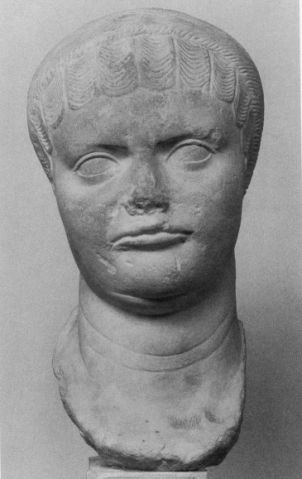
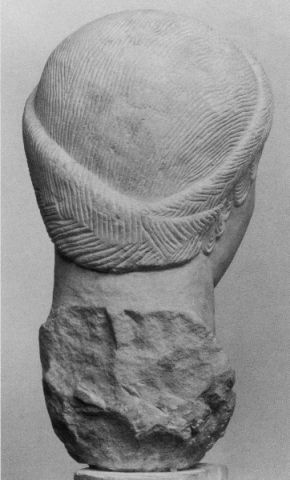
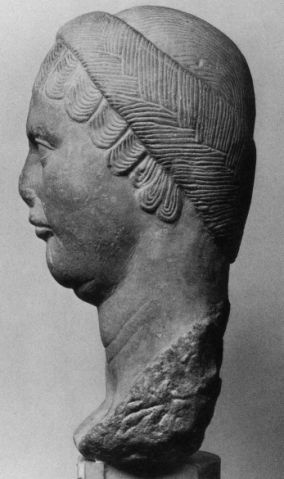
Portrait head for insertion of woman with full face and broad flat 'crown' braid. From Italy. Later fourth century.
Record details
Photographs
Bibliography
- Giuliano, A. (ed.), Museo Nazionale Romano. Le Sculture I,9. Magazzini. I Ritratti. Parte II, Rome 1988, 422-4, no. R321
Discussion
DESCRIPTION (Object)
Over life-size head for insertion. H: 37.5 cm. Luna marble.
The head for insertion is completely preserved. The tip of the nose is broken. There are chips in the left eyebrow and chin.
The hair has been rendered in three schematic and ornamental sections with a flat chisel. The top of the head shows long parallel lines of a claw chisel that run from front to back. The braids which encircle the head have a herring bone pattern, and the locks around the face are rendered as repeating U-shaped cuts of the flat chisel. Creases under the chin and around the neck have also been made with a flat chisel. The eyes are unmarked. There is no indication of drill work.
The head has been re-cut from another portrait which explains the discrepancy between the bland rendering of the facial features and the decorative but flat hair, and possibly also the unusual formation of the lower face.
PROVENANCE
Unknown.
DESCRIPTION (Subject)
The head depicts a woman with a hairstyle of the fourth century and a distinctive physiognomy. The hairstyle consists of two braids that are wound around the head to form a turban. Beneath these braids and around the face are a series of crimped looping locks which completely conceal the ears. Above these braids is an area of hair that is unparted and straight.
The face is round but with a heavily receding chin. The upper area of the face maintains some regularity. The brow is broad, and the eyes are widely-spaced. The lower face is in contrast distinctive. The mouth is thin-lipped and unusually wide. The naso-labial folds are emphatically marked as is a line indicating a double chin. The chin and mouth formation are especially striking in profile. Two Venus rings, to be interpreted as signs of beauty rather than age, encircle the neck.
DATE
The hairstyle of encircling braids was popular in the early second century and again in the mid-fourth century. The particular combination of the crimped loops around the face and the braids with a net-like pattern belong definitively to the fourth century (Schade). Portraits showing a similar hairstyle include LSA-964 and LSA-978.
The shape of the eyes, the thin upper lid, and the flat unmarked eyeball are all features of first century portraiture. It is clear that this head has been cut from an earlier portrait.
Discussion references
- Schade, K., Frauen in der Spätantike--Status und Repräsentation, Mainz 2003, 184, no. I 22, pl. 37 (Valentinian)
- von Heintze, H. ‘Ein spätantikes Mädchenportät in Bonn. Zur stilitischen Entwicklung des Frauenbildnisses im 4. und 5. Jahrhundert’, Jahrbuch für Antike und Christentum 14, Münster 1971, 74, no. III 9 (325-330)
Cite: Last Statues of Antiquity, LSA-975 (J. Lenaghan).