
LSA-978
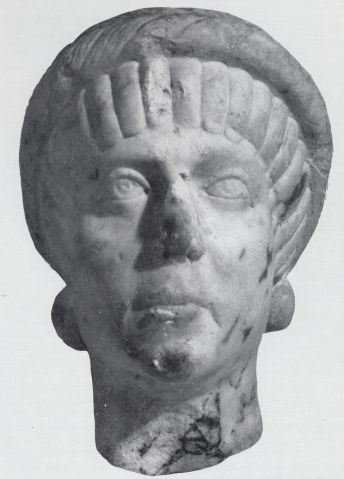
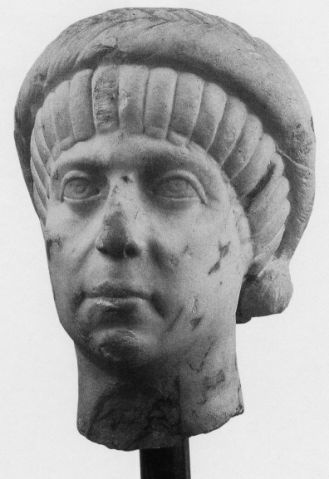
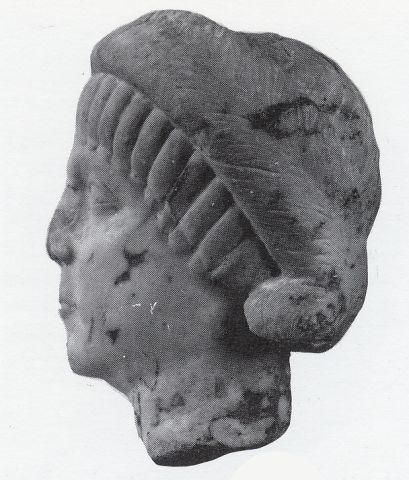
Portrait head of mature woman with tightly crimped locks and thick encircling braid. From Italy. Fourth century.
Record details
Photographs
Bibliography
- Settis, S. (ed.), Camposanto Monumentale di Pisa. Le Antichità. II., Pisa 1984, 147-8, no. 72 (L. Faedo)
Discussion
DESCRIPTION (Object)
Life-size head. H: 23 cm. H (forehead to chin): 13 cmLuna marble
The head was worked separately from its body. In the neck is a dowel hole. There is a chip in the front of the neck, and significant chips in the neck. There are abrasions elsewhere.
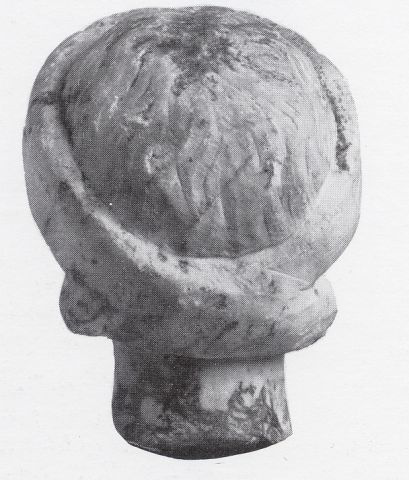
The hair has been rendered carefully with a flat chisel. The back has not been given full representational detail. The irises are engraved semi-circles, and the pupils are drilled holes.
PROVENANCE
A gift of Luisa Berni from Pugnano (Pisa) in 1813. It was given with a head of Julius Caesar, a head of Agrippa, a fragment of sarcophagus, and some works after the antique.
DESCRIPTION (Subject)
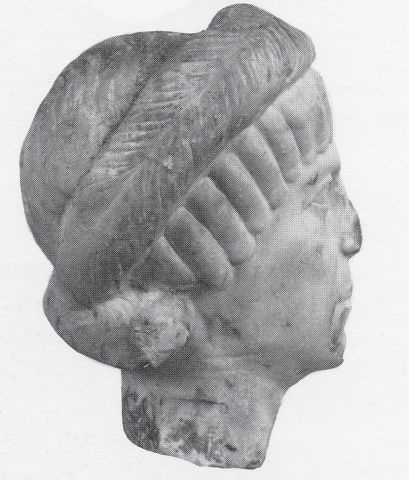
The head depicts a woman with an oval face and a hairstyle consisting of three distinct forms. The hair around the face is crimped into separate vertical bands which entirely conceal the ears. Two large braids of twisted hair originate behind the ears and are pulled around the head above the ears. The hair at the crown of the head falls naturally to all sides in long waves.
The brow is low; the eyes have high arching upper lids; and the nose is short. The cheeks are long, and the chin long and projecting.
DATE
The hairstyle of encircling braids was popular in the fourth century. Portraits of an Empress (now in Como, LSA-574) and of unidentified women in Rome (LSA-970 and LSA-977) show similar hairstyles.
On the basis of stylistic analysis of the face and comparisons to other imperial portraits of the second half of the fourth century (see, for example, ‘Valentinian’, LSA-597), L. Faedo considers this portrait to belong to c. 380. Schade also considers it to be Theodosian.
Discussion references
- Ensoli, S. and E. La Rocca (eds.), Aurea Roma: dalla città pagana alla città cristiana, Roma 2000, 579-80, no. 266 (mid 4th c.?)
- Schade, K., Frauen in der Spätantike--Status und Repräsentation, Mainz 2003, 186-7, no. I 26, pl. 40.1
- von Heintze, H. ‘Ein spätantikes Mädchenportät in Bonn. Zur stilitischen Entwicklung des Frauenbildnisses im 4. und 5. Jahrhundert’, Jahrbuch für Antike und Christentum 14, Münster 1971, 73-4, no. III 6 (first third of fourth century)
Cite: Last Statues of Antiquity, LSA-978 (J. Lenaghan).