
LSA-99
Fragment of inscription, possibly from base for statues of Diocletian and Maximian. Eleusis (Achaea). 286-305
Record details
Photographs
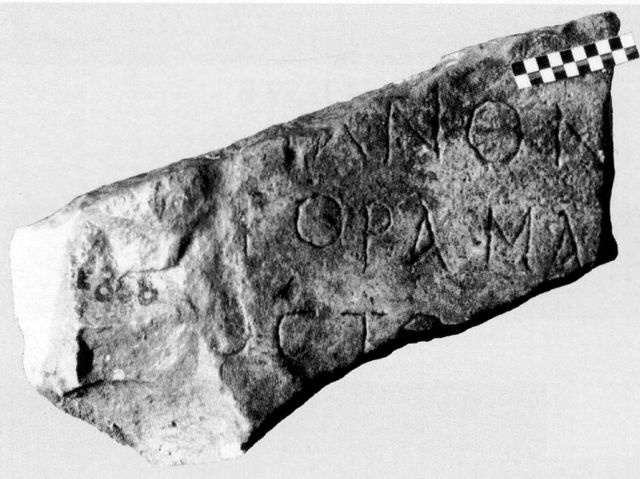
Inscription
[------Διοκλητ]ι̣̣ανὸν------- / [------Ἀυτοκρά]τορα ΜΑ[---] / -----------ΟΣΤΟ̣------- / --------------------------
Inscription translation
... Diocletian (?) ... the emperor (?) Ma[ximian ?] ... the most (?) ..
Bibliography
- Inscriptiones Graecae, II/III 3422
- Inscriptiones Graecae, II/III(2) 13267
Discussion
INSCRIPTION
Small parts of three lines survive:
[------Διοκλητ]ι̣̣ανὸν------- / [------Ἀυτοκρά]τορα ΜΑ[---] / -----------ΟΣΤΟ̣------- --------------------------
' ... Diocletian (?) ... the emperor (?) Ma[ximian ?] ... the most (?) ...'
DESCRIPTION (from Sironen 1997 and the published picture)
Fragment of a block of whitish marble, broken on all sides. The inscribed face is uneven, possibly an indication of re-use.
The accusative in the inscription suggests a statue base. The inscription has been attributed to the emperors Diocletian and Maximian by Sironen, although the restored text does not conform to the usual formula of late Roman imperial dedications in Achaea (Sironen 1994, 24; Sironen 1997, 64) (for instance, the word autokrator usually does not precede the name of the co-regent, as appears to be the case here).
PROVENANCE AND LOCATION
The stone was found in Eleusis and is now in the storerooms of the Museum in Elefsina, inv. no. E 868.
HONORAND AND DATE
Diocletian was Augustus 284-305; Maximian was Augustus 286-305 (Kienast 1996, 268). If this was a dedication to the two of them, the date would be provided by their common reign, AD 286-305.
Discussion references
- Sironen, E., The late Roman and early Byzantine inscriptions of Athens and Attica, Dissertation - University of Helsinki 1997, 64 no. 9
- Sironen, E. , 'Life and administration of late Roman Attica in the light of public inscriptions'
P. Castrén, Post-Herulian Athens : aspects of life and culture in Athens, A.D. 267-529 , Helsiniki 1994, 15-62, 24 no. 8
Cite: Last Statues of Antiquity, LSA-99 (Ulrich Gehn).