
LSA-993
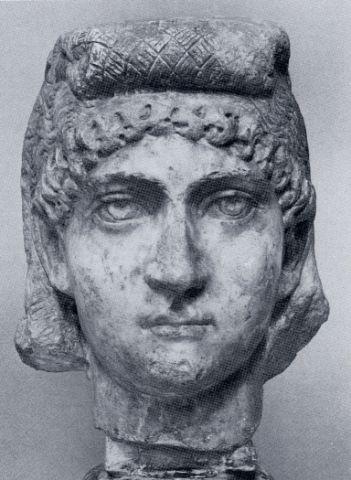
Portrait head of young woman with large central braid and corkscrew brow locks. From Italy. Late third to early fourth century.
Record details
Photographs
Bibliography
- Fittschen, Klaus and P. Zanker, Katalog der Porträts in den Capitolischen Museen und den anderen kommunalen Sammlungen der Stadt Rom, Band III , Mainz 1983, 115, no. 173, pl. 203
Discussion
DESCRIPTION (Object)
Life-size head. H: 25 cm. H (chin to crown): 21 cm. Marble.
The head is broken irregularly through the neck; the break rises at the back left. The hair on either side of the neck is broken. The hair over the brow is abraded. The nose has been restored in plaster.
The hair around the brow has been defined with a drill, and the hair of the central braid with a flat chisel. The irises are indicated by strong, semicircular lines of the flat chisel. The pupils are large and have a deep crescent shape, consisting of more than two drill holes. The outer corners of the eyes are also slightly pointed because of the manner in which the upper lid overlaps the lower one.
PROVENANCE
Unknown
DESCRIPTION (Subject)
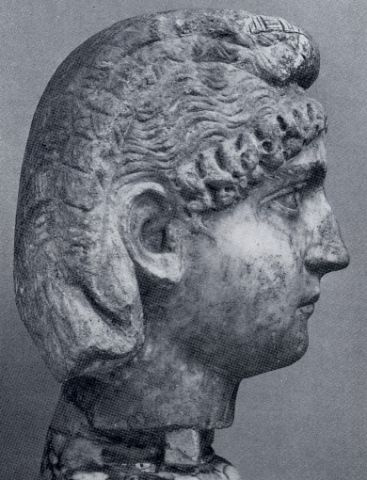
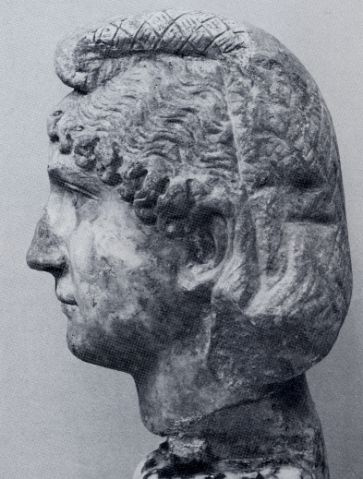
The head portrays a woman who turns to her left and who wears a version of the ‘central’ braid hairstyle popular in the late third to early fourth centuries.
The face has an unarticulated U-shape. The brow is low; the eyebrows regular; and the eyes large. The mouth is small, bow-shaped, and with carefully rendered philtrum above it. The chin completes the oval form of the face without distinctive recession or prominence. There are no signs of age.
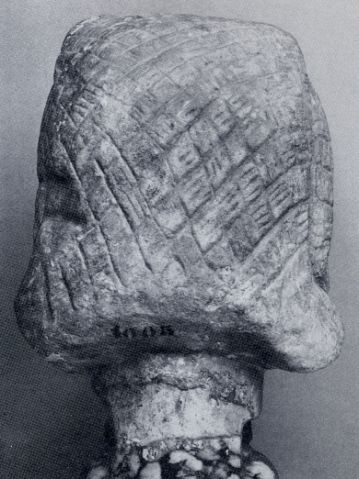
The hair over the brow is perhaps the most distinctive aspect of the head. It falls in short curls. The hair behind it is long and wavy and tucked around the ears. It is then collected in a series of braids which make a broad plait which is pulled upwards from the middle of the neck to the front of the brow where it rolls under itself. Over the brow the plait extends in width from the outer corner of one eye to the outer corner of the other.
IDENTIFICATION
The hairstyle repeats exactly on another portrait from Rome (LSA-1592). The physiognomies are, however, different. Thus, it is impossible to affirm that the two portraits represent the same woman. In addition, neither of the heads is of a size or quality that would suggest an imperial portrait.
DATE
The central braid that reaches the brow is depicted on imperial portraits first with Ulpia Severina (270-275). The fashion continues into the early fourth century. Here, the central braid is broad and and has been combined with a short curled fringe which has been drilled out and which frames the brow in a low arch. This elaboration of the style seems to post-date the Severina portraits; compare, for example, both LSA-767 and LSA-1592. Moreover, Fittschen and Zanker believe that there is a stylistic connection between the facial structure of this head and male portraits of the tetrarchic period. A significant technical detail are the large pupils which seem more likely during or after the Tetrarchy.
Discussion references
- Bergmann, M., Studien zum römischen Porträt des 3. Jahrhunderts n. Chr., Bonn 1977, 192, pls. 55.2 and 56.2 (later third century)
- Donati, A. and G. Gentili, Costantino il Grande. La civiltà antica al bivio tra Occidente e Oriente, Milan 2005, 292, no. 138 (M. Mattei)
Cite: Last Statues of Antiquity, LSA-993 (J. Lenaghan).