
LSA-995
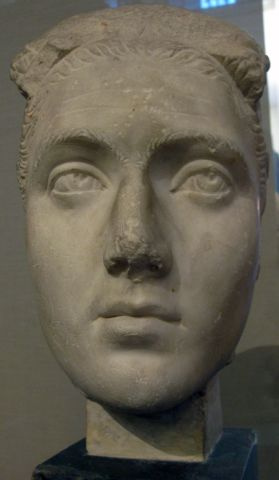
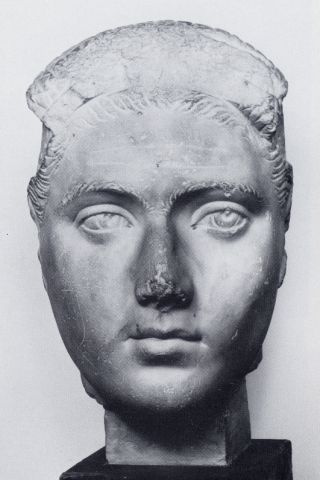
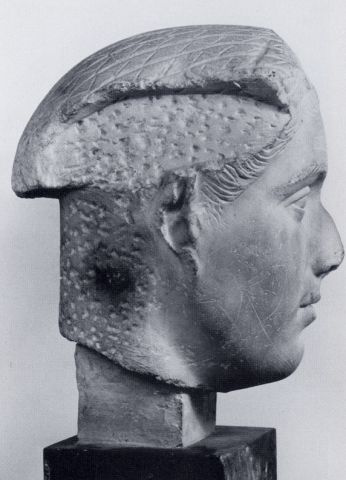
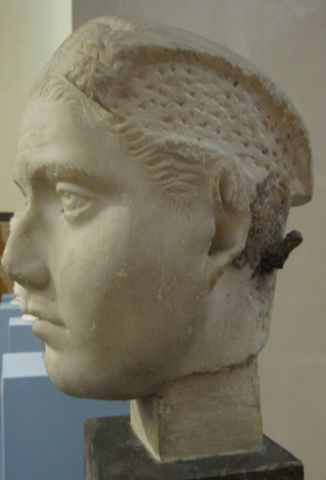
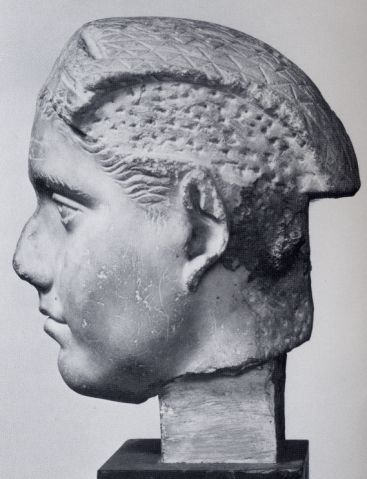
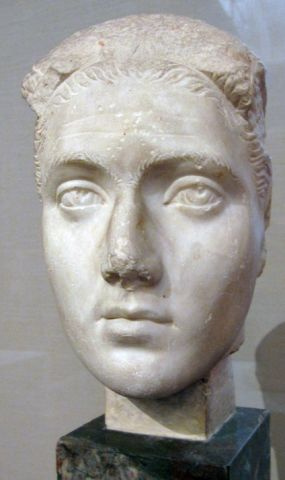
Portrait head of woman with central braid and separately worked hair sections. From Rome. Late third century.
Record details
Photographs
Bibliography
- Fittschen, Klaus and P. Zanker, Katalog der Porträts in den Capitolischen Museen und den anderen kommunalen Sammlungen der Stadt Rom, Band III , Mainz 1983, 116, no. 175, pl. 204
Discussion
DESCRIPTION (Object)
Over life-size head. H: 24 cm. H (chin to crown): 23 cm. Marble.
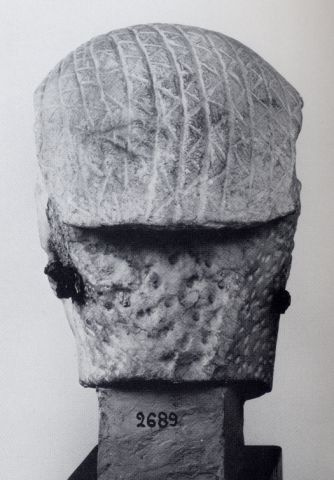
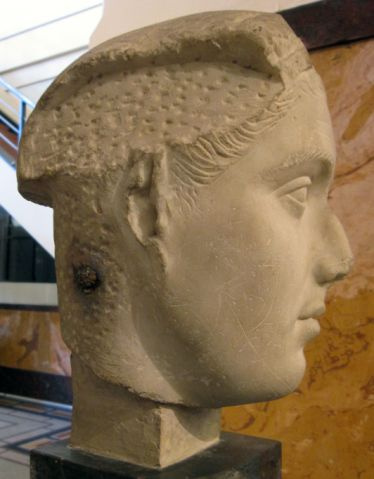
The head is broken at the top of the neck. At the front the break is located at the juncture between chin and neck; it rises upward as it moves back. The head had two or three separately worked areas at the sides and back of the head. These are now missing. The shell of the ear has broken off completely on the right side, and the back part of the shell is missing on the left side. The tip of the nose is abraded.
The three separately worked areas are: (1) on the right side of the head from the brow to c. 1 centimetre before the back of the head and from the top of the ear to c. 5 centimetres below the top of the head. The area has been rough picked, and the separate piece was presumably attached with plaster. (2) the same area on the left side of the head. Again the area for the join has been roughly picked to enhance the grip. (3) the area at the back of the head which extends from ear to ear and from break at the neck up to the level of the middle of the ear. The surface here too has been rough picked but is higher than the two patches at the side of the head. The upper edge is defined by a finished, horizontal shelf at the middle of the back of the head. This separate piece was attached by two iron dowels, both of which are still extant. That on the left side protrudes significantly. The one on the right side is broken.
The hair on the brow has been engraved with a flat chisel. The engraving is sketchy in front of the lateral patch on the right side. The criss-cross pattern of the braids at the top of the head has also been engraved, as have the eyebrows and two lines across the brow. The irises, again engraved, are large and because they touch the line of the lower lid, they are not semicircular. On the right eye, the iris is in fact two separate arcs. The pupils consist of two, close but non-contiguous drill points.
PROVENANCE
Found on the Oppian Hill during the construction of the via dei Fori Imperiali in 1936.
DESCRIPTION (Subject)
The head portrays a woman who turns to her left and who wears a version of the ‘central’ braid hairstyle popular in the late third to early fourth centuries. It is unusual in two details: (1) the sides and back of the hairstyle have been worked in separate pieces and (2) it wears a hairstyle that seems to have both crown and an encircling braids (such as LSA-255 and LSA-256).
The physiognomy is distinctive. The face is full with broadly-spaced cheekbones and a tall brow that is traversed by two shallow lines. The eyebrows have a low arch and meet at the bridge of the nose. The eyes are narrow, and the right eye has an especially finely-pointed inner canthus. The nose is hooked and the cheeks softly modelled. The mouth is small with bow-shaped lips and up-turned corners. The lower lip pouts over the rounded chin.
The hair is combed off the brow in flat locks. Short schematic lines indicate a few hairs that fall in front of the ears. Above these locks is band of hair, visible mainly in the profile views, which is defined above and below by continuous engraved lines, and which must be an encircling braid. Above this, are the remains of the rolled end of the large central plait which is visible on the top of the head. The lower portion of the plait, which would have begun behind the ears, was rendered in the separately worked pieces.
DATE
The central braid that reaches the brow is depicted on imperial portraits first with Ulpia Severina (270-275). The fashion continues into the early fourth century. Here, a broad central braid seems to be combined with an encircling braid. The encircling braid style would become the dominant style of the fourth century. Thus, this head seems to be belong to the transitional period between the third and fourth centuries.
The head seems almost certainly to have been adapted from an earlier portrait. This is the most obvious explanation for the separately worked hair sections and rather crude engraving of hair on around the brow and of the creases on the brow. The original portrait must have had a tall brow with hair clearly brushed away from it. It also would have had no hair behind the ears on the neck. Forti suggested that the original head dated to c. 230-240. To me, it seems more likely that the original head wore a toupee hairstyle of the late first or early second century. This would explain the tall brow with virtually no trace of hair and the lack of hair around the ears and on the sides of the neck. Even the plastic rendering of the fleshy face is in keeping with that date.
HONORAND AND ORIGINAL CONTEXT
Neither the physiognomy nor hairstyle can be related to any historic personage. Found in the centre of Rome, it probably represented an upper class Roman woman of importance. Because the back of the head was carefully added, it was visible. Thus, the head belonged either on a bust or on an unveiled statue.
Discussion references
- Bergmann, M., Studien zum römischen Porträt des 3. Jahrhunderts n. Chr., Bonn 1977, 192, pls. 55.4 and 56.4 (similar to Carinus)
- Forti, L. 'Quattro ritratti ed un rilievo del nuovo Museo del Campidoglio', Rendiconti della Accademia di archeologia, lettere e belle arti, 30, Naples 1955, 12-16, pl. 2.
Cite: Last Statues of Antiquity, LSA-995 (J. Lenaghan).