
LSA-998
Base for statue of Proclianus, governor of Achaea. Argos (Achaea). Mid fourth century.
Record details
Photographs
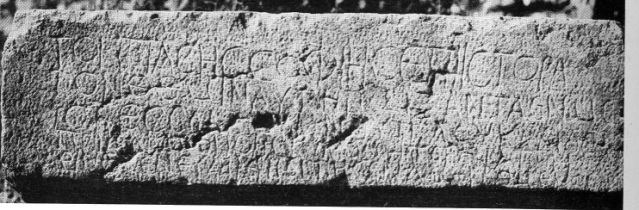
Inscription
τὸν πάσης σοφίης ἐπιίστορα, / τὸν Θέμιν αὐτὴν
δίξαντα ἐν με-/ρόπεσσ’, ὄλ[β]ιον ἀν[θ]ύπ(ατον)
Λευκάδιος / Προκλιανὸν, ἑῆς κοσμήτορα πάτρης, /(5)
εἵνεκεν εὐδικίης στῆσεν ἀμειβόμενος.
Inscription translation
Leucadius set (this) up (to) him who is learned in all wisdom, who displayed Themis herself among the mortals, the blessed governor (proconsul) Proclianus who established good order in his home town, as recompense for his justice
Bibliography
- Feissel, D. & Philippidis-Braat, A., Inventaires en vue d’un recueil des inscriptions historiques de Byzance, 3. Inscriptions du Péloponnèse, (à l’exception de Mistra)., Travaux et mémoires, 9, Paris 1985, 267-395, 289 no. 28
Discussion
INSCRIPTION
Verse inscription of two elegiac distichs laid out in five lines:
τὸν πάσης σοφίης ἐπιίστορα, / τὸν Θέμιν αὐτὴν
δίξαντα ἐν με-/ρόπεσσ’, ὄλ[β]ιον ἀν[θ]ύπ(ατον)
Λευκάδιος / Προκλιανὸν, ἑῆς κοσμήτορα πάτρης, /
εἵνεκεν εὐδικίης στῆσεν ἀμειβόμενος.
'Leucadius set (this) up (to) him who is learned in all wisdom, who displayed Themis herself among the mortals, the blessed governor (proconsul) Proclianus who established good order in his home town, as recompense for his justice'
The verse inscription praises the justice and wisdom of the governor (proconsul) Proclianus. Argos is referred to in the inscriptions as ἑῆς ... πάτρης ('... of his hometown'), but it is not clear whether this applies to Proclianus, the governor and honorand, or to Leucadius, the awarder of the statue.
Letter height 2-4 cm.
DESCRIPTION (from Charneux 1956 and the published photo)
Rectangular limestone block with mouldings at bottom. H 26 cm, W 74 cm, D 59 cm. The block is re-used and has been turned around for its present use; the actual bottom was originally a crowning element. The inscribed surface is roughly finished with a claw, various cracks are running through the inscription. There are footprints for a bronze statue and a deep circular hole on the top face.
PROVENANCE/ LOCATION
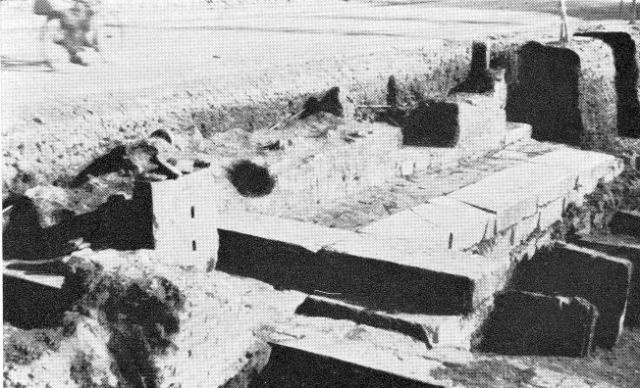
The block was found in 1952 during excavations in the forum area of Argos, in a wall of a late-antique building made out of spolia material over an earlier colonnaded hall ('salle hypostyle', for the findspot see Roux 1953 p. 245 fig. 32, Vollgraff 1920). There is no published record of its present location.
HONORAND, AWARDER AND DATE
The inscription tells us that the honorand Proclianus was governor (proconsul) of Achaea, and (possibly) a native of Argos (PLRE I, 741 Proclianus 4).
The epigram fits in form and motifs the honorific inscriptions for late-antique governors common in the fourth century (Robert 1948). A terminus post quem for Proclianus' holding of office is provided by the re-elevation of the governorship of Achaea to proconsular rank (after it had been downgraded in the wake of the tetrarchic provincial reform), probably in 324 (Groag 1946, 16). The late-antique wall in which the base was found is dated by coins to the late fourth century, a remodelling which has plausibly been associated with the Gothic raid of 395 (Roux 1953). This provides a probable terminus ante quem for the elevation of the base.
The awarder Leucadius was with all probability a local notable; he is otherwise unknown (and has no PLRE-entry).
ACKNOWLEDGEMENTS
We are deeply indebted to Erkki Sironen for help with the interpretation and translation of this inscription.
Discussion references
- Charneux, P., Inscriptions d'Argos, Bulletin de Correspondance Hellénique 80, 598-618, Paris 1956, 616-18
- Groag, E., Die Reichsbeamten von Achaia in spätrömischer Zeit, Budapest 1946, 22
- Jones, A. H. M. et al., The Prosopography of the Later Roman Empire. Vol. I 260-395, Cambridge et al. 1971 (1975), 741 Proclianus 4
- Robert, L., Epigrammes du Bas-Empire (Hellenica IV), Paris 1948
- Roux, G., Argos, Bulletin de Correspondance Hellénique 77, 243-53, Paris 1953, 244-5 fig. 32
- Vollgraff, W., Fouilles d'Argos, Bulletin de Correspondance Hellénique 44, 219-26, Paris 1920, 219-20
Cite: Last Statues of Antiquity, LSA-998 (Ulrich Gehn).