
LSA-999
Base for statue of Callippinus, governor of Achaea. Argos (Achaea). Fourth to early fifth century
Record details
Photographs
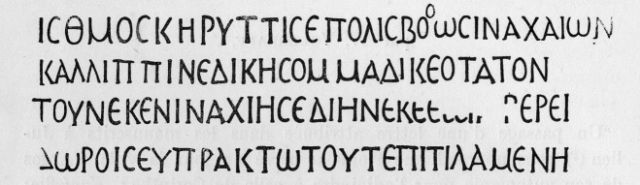
Inscription
Ἰσθμὸς κηρύττει σε, πόλις βοοῶσιν Ἀχαιῶν
Καλλιππῖνε, Δίκης ὄμμα δικεότατον·
τοὔνεκεν Ἰναχίη σε διηνεκέεσ̣σ̣ι̣̣ γ[ε]ρέρει
δώροις, Εὐπράκτῳ τοῦτ’ ἐπιτιλαμένη.
Inscription translation
The Isthmus proclaims you, the cities of the Achaeans (= Greeks) aclaim you, Callippinus, the most righteous eye of Dike. Therefore Inachie (= Argos) honours you with permanent gifts having charged Eupraktos with it
Bibliography
- Feissel, D. & Philippidis-Braat, A., Inventaires en vue d’un recueil des inscriptions historiques de Byzance, 3. Inscriptions du Péloponnèse, (à l’exception de Mistra)., Travaux et mémoires, 9, Paris 1985, 267-395, no. 29
Discussion
INSCRIPTION
Verse epigram consisting of two elegiac distichs:
Ἰσθμὸς κηρύττει σε, πόλις βοοῶσιν Ἀχαιῶν
Καλλιππῖνε, Δίκης ὄμμα δικεότατον·
τοὔνεκεν Ἰναχίη σε διηνεκέεσ̣σ̣ι̣̣ γ[ε]ρέρει
δώροις, Εὐπράκτῳ τοῦτ’ ἐπιτιλαμένη.
'The Isthmus proclaims you, the cities of the Achaeans (= Greeks) aclaim you, Callippinus, the most righteous eye of Dike. Therefore Inachie (= Argos) honours you with permanent gifts having charged Eupraktos with it'.
The epigram praises the just rule of Callippinus (Dike being a goddess of Justice), who was therefore certainly a governor of Achaea, and refers to the statue ('permanent gifts') he is rewarded with. The city of Argos is styled 'Inachie' in the epigram: Inachos is the main river of Argos, worshipped as a god, and also the first (mythological) king and progenitor of the Argive heroes.
Letter height not recorded.
DESCRIPTION (from Vollgraff 1945)
Rectangular statue base of white-greyish limestone. H 41 cm, W 71 cm, D 68 cm.
PROVENANCE AND CURRENT LOCATION
The block was found in 1930 in the forum area of Argos, in the ruins of a late-antique building built out of spolia over an earlier colonnaded hall (Vollgraff 1945, 5-6; cf. LSA-998). There is no published record of its present location.
HONORAND, AWARDER AND DATE
The epigram fits in form and motifs the late-antique honorific epigrams to high ranking state officials common in the fourth century, and into the fifth (Robert 1948). With justice featuring prominently in the epigram, and the 'cities of the Achaeans' pronouncing the justice of Callippinus, he was certainly a governor of Achaea (PLRE I, 175 Callippinus).
The base was set up in a late Roman portico which Vollgraff 1945, 6 dated 'later than the destruction of the city by the Goths in 267' ('postérieur à la destruction de la ville par les Goths en 267'). Callippinus is not included by Groag 1946 in his list of governors of Achaea, and there is nothing in the inscription to provide a tighter dating than the broad period c.300-450.
The awarder Eupractus was probably a local aristocrat, he is otherwise unknown (no PLRE-entry)
Discussion references
- Groag, E., Die Reichsbeamten von Achaia in spätrömischer Zeit, Budapest 1946
- Jones, A. H. M. et al., The Prosopography of the Later Roman Empire. Vol. I 260-395, Cambridge et al. 1971 (1975)
- Robert, L., Epigrammes du Bas-Empire (Hellenica IV), Paris 1948
- Vollgraff, W., Argos dans la dépendance de Corinthe au IVe siècle, L'Antiquité Classique 14, 5-28, Bruxelles 1945
Cite: Last Statues of Antiquity, LSA-999 (Ulrich Gehn).